- Our Products
-
Choose your Cabinet Style
-

Kitchen cabinet edge profile options wholesale OEM buyers choose directly shape how a door line looks, wears, and photographs once it lands on a showroom floor. Square, eased, radius, bullnose, and beveled edges each interact differently with thermofoil wrap, lacquer spray, and melamine edge banding.
This guide breaks down the profiles a Vietnam OEM factory runs most often on a CNC production line, and what each option means for tolerance, finish compatibility, and landed cost on a private label program.
A cabinet door edge takes more physical contact than almost any other surface in a kitchen — hands, hips, grocery bags, and doors bumping into each other during normal use. A profile that chips or delaminates after six months of use turns into a warranty claim, and warranty claims on a 150-container-a-month program are expensive to trace back to a specific production run.
Edge profile is also a design signal. Retailers and builders read a square edge as modern and a softened radius or bullnose as transitional or traditional. Getting the profile wrong for the target market segment is a common reason private label buyers request a running change mid-program, which adds tooling time and delays the next container.
Edge profile consistency also matters across a multi-SKU program. A buyer running both painted Shaker and thermofoil slab doors under one private label brand needs the flat-panel line’s eased edge to visually match the Shaker line’s bullnose in overall softness, even though the profiles differ — otherwise the two door styles look like they came from different factories when displayed side by side in a showroom.
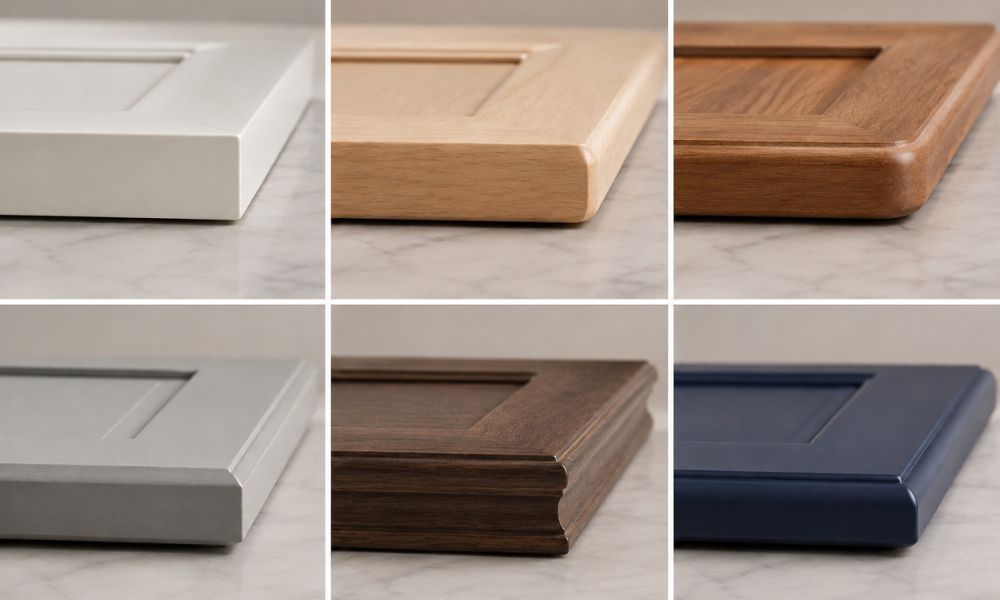
Comparison of common kitchen cabinet edge profiles used in OEM production
Most wholesale programs settle on one of five or six kitchen cabinet edge profile options wholesale OEM factories run in volume. Each one changes machining time, sanding labor, and how forgiving the edge is during container loading and final-mile handling.
Most buyers narrow the list to two or three edge profile candidates during the initial sample round, then confirm one after seeing how each performs under the target finish. Requesting physical edge samples in the actual substrate and coating — not just a rendering — is the only reliable way to judge chip resistance and coating pooling before committing to a production run.
The finish applied to a door changes which edge profiles are realistic. Thermofoil wraps around a radius or eased edge cleanly because the vinyl film needs a curve to bond to without cracking at the corner — a true square edge is a common failure point for thermofoil peel-back over time. Programs running a thermofoil kitchen cabinet line default to eased or bullnose profiles for this reason.
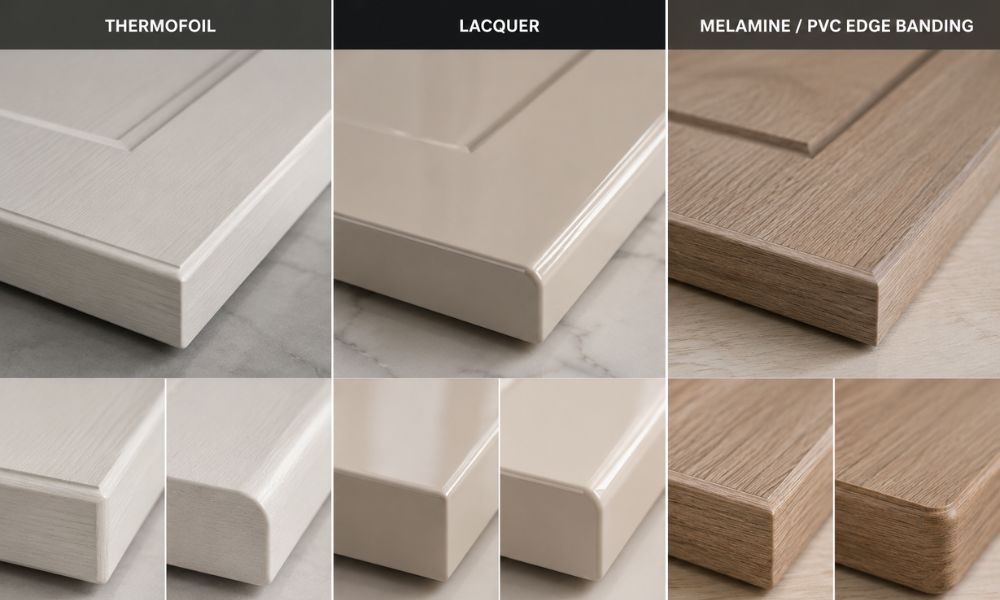
How different cabinet finishes interact with edge profiles
Lacquer and high gloss finishes can hold a crisper square edge because the coating is sprayed rather than wrapped, though sharp corners are still more exposed to chip-through during spraying and buffing. A high gloss kitchen cabinet program typically specifies a slight eased edge even on an otherwise square-look door, just enough to protect the coating without changing the visual line.
The same logic applies to a lacquer kitchen cabinet finish, where edge consistency affects how evenly light reflects off the door face. Melamine and PVC edge banding lines run fastest on eased or radius profiles because the banding material has a minimum bend radius; forcing it around a true square corner increases banding failure rate at the factory and after shipping.
Contemporary and transitional kitchen styles have driven demand toward eased and square edges over the past several design cycles, while bullnose and ogee profiles remain steady in traditional-style renovation and new-construction segments. Builders tracking new single-family and multifamily construction volume — reported by the National Association of Home Builders — use these design cycles to plan cabinet specs a full season ahead of a project’s cabinet delivery date.
A wholesale buyer stocking multiple SKUs for different regional markets often keeps both an eased-edge contemporary line and a bullnose traditional line active at the same time, rather than betting the full program on one profile. Confirming which profile each SKU uses at the sample stage — and keeping that mapping consistent across reorders — avoids a mismatch between what a showroom displays and what ships in the next container.
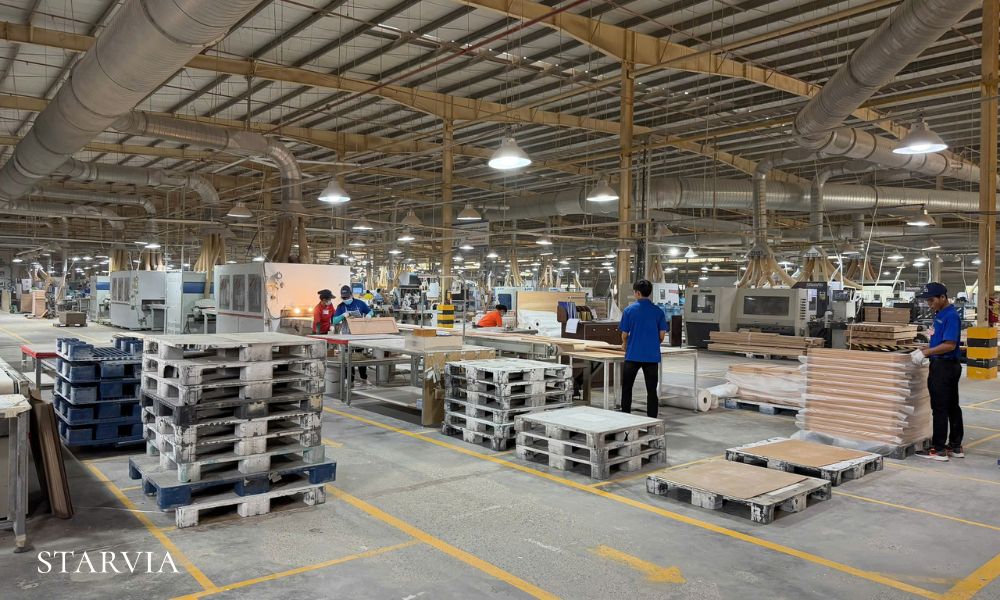
CNC machining helps maintain consistent cabinet door edge profiles across production runs
Edge profile consistency across a container run comes down to the CNC tooling and tolerance the factory holds, not just the router bit shape. Starvia’s Vietnam OEM factory runs Homag CNC equipment holding ±0.5mm tolerance, which keeps a radius or bevel dimension from drifting between the first door in a run and the last.
That tolerance matters more than it sounds. A radius edge that drifts by even a millimeter across a production run is visible once doors are installed side by side in a kitchen, especially under raking light near a window. Buyers sourcing kitchen cabinet edge profile options wholesale OEM factories offer should ask for the tooling tolerance spec directly rather than relying on a sample door alone, since a single sample does not prove batch consistency.
A pre-shipment inspection for kitchen cabinet edge profile options wholesale OEM programs typically checks radius or bevel dimension at multiple points per door, sand-through risk at the profile’s highest wear point, and coating thickness at the edge versus the flat face. Doors that pass a flat-face gloss or color check can still fail at the edge if the profile was sanded through during finishing.
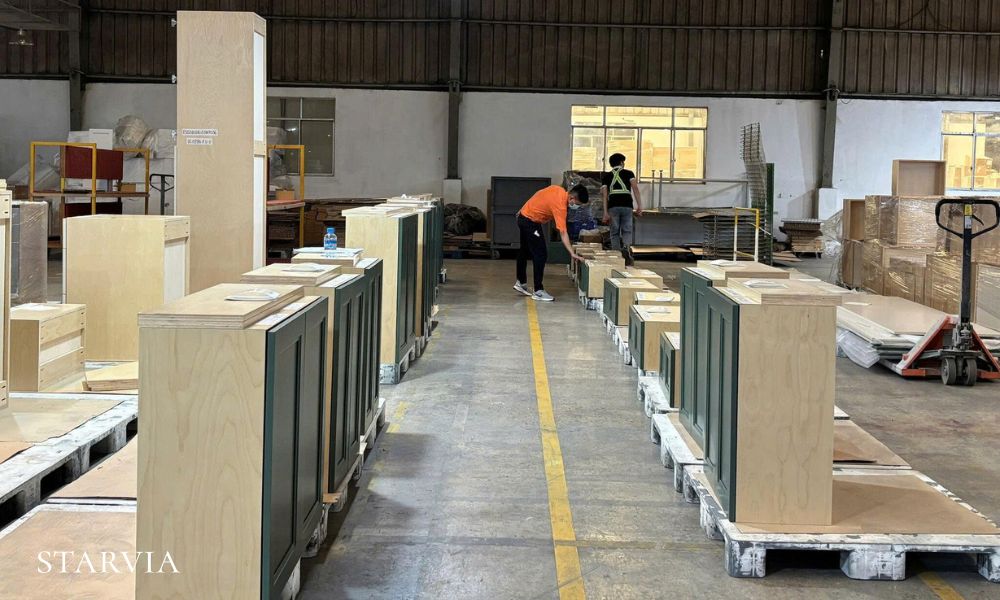
Quality control inspection of cabinet door edge dimensions and finish
Industry design guidance from the National Kitchen & Bath Association treats edge detailing as part of overall door specification, alongside species and finish — a reminder that edge profile is a spec line item, not an afterthought, when documenting a private label program. Substrate sourcing matters too: doors built on FSC-certified panel stock hold edge profiles more predictably than uncertified substrate with inconsistent density.
Edge profile also affects hinge cup boring tolerance near the door edge, since a bullnose or ogee profile leaves less flat material at the boring point than a square or eased edge. Buyers combining a decorative edge profile with soft-close hinges should confirm boring placement during sampling — see Starvia’s hinge types guide for standard boring specifications.
For a full walkthrough of what an import QC checklist covers beyond edge profile, see Starvia’s kitchen cabinet import checklist.
Square and eased edges are the fastest profiles to tool and run, since they need minimal router bit changeover and less hand-sanding time per door. Ogee and other decorative profiles add machining and finishing labor, which shows up as a small per-door upcharge rather than a change to the base FOB range published in Starvia’s FOB price guide.
Edge profile choice rarely changes overall lead time on its own, but switching profiles mid-program does. A factory already tooled for eased-edge doors needs a changeover window to retool for bullnose or ogee, which is worth planning around the production windows described in Starvia’s lead time guide rather than requesting the switch inside an active container run.
Buyers planning a multi-container program should lock the edge profile spec before the first production run, not after. A profile change discovered mid-program forces a full retool, a new sample-approval cycle, and often a short delay to the container already queued for loading — costs that are easy to avoid by confirming edge profile during the sample stage alongside color, sheen, and hardware.
What is the most durable kitchen cabinet edge profile for wholesale programs?
An eased edge with roughly a 1/8-inch radius is generally the most durable choice for high-volume wholesale programs, since it resists chipping better than a true square edge while still reading clean and contemporary.
What kitchen cabinet edge profile options wholesale OEM factories offer work best for painted shaker doors?
Bullnose and beveled edges are the most common choices for painted Shaker doors, since both hold paint evenly at the edge and match the traditional profile buyers expect from a Shaker door style.
Does edge profile affect kitchen cabinet FOB pricing?
Standard profiles like square and eased edges do not change base FOB pricing meaningfully, while decorative profiles such as ogee typically carry a small per-door upcharge for the added machining and sanding time.
Can edge profiles be mixed within one container order?
Yes, factories running CNC production can mix edge profiles within the same container as long as each door style and profile combination is confirmed during the sample approval stage before mass production starts.
How many edge profile samples should a buyer request before mass production?
Most experienced buyers request two to three profile candidates in the actual finish and substrate, since a rendering or catalog photo does not show how a profile handles light, chipping, or coating pooling at the edge.
Do export buyers need different edge profiles for different destination markets?
US, Canadian, Australian, and European buyers generally request the same core profiles — square, eased, and bullnose — though regional design preference shifts the ratio: European-style frameless programs lean toward square and eased edges, while traditional US and Australian face-frame programs request more bullnose and beveled options.
Choosing among kitchen cabinet edge profile options wholesale OEM factories offer comes down to matching the profile to the finish, confirming CNC tolerance, and locking the spec before mass production rather than mid-run. Buyers evaluating a Vietnam OEM factory for a private label program can review Starvia’s production capabilities or request edge profile samples alongside standard finish samples.


 View collection
 View collection
 View collection
 View collection