- Our Products
-
Choose your Cabinet Style
-

Understanding kitchen cabinet lead time Vietnam OEM factory schedules is the foundation of a well-run import program. Miscalculating lead time — even by two weeks — cascades into missed project deadlines, warehouse holding costs, and strained customer relationships. This guide breaks down every phase of the production and shipping timeline, the factors that compress or extend it, and how to build a reliable import calendar around Vietnam OEM factory schedules.
When buyers ask about kitchen cabinet lead time Vietnam OEM factory, they typically mean production time. In practice, total lead time from purchase order to product in your warehouse has five distinct phases — and only one of them is factory production:
Total cycle from signed PO to US port arrival: **55–82 days** for a standard program. Importers who plan around 45 days routinely face surprises — the number should be 60–75 days for reliable planning.
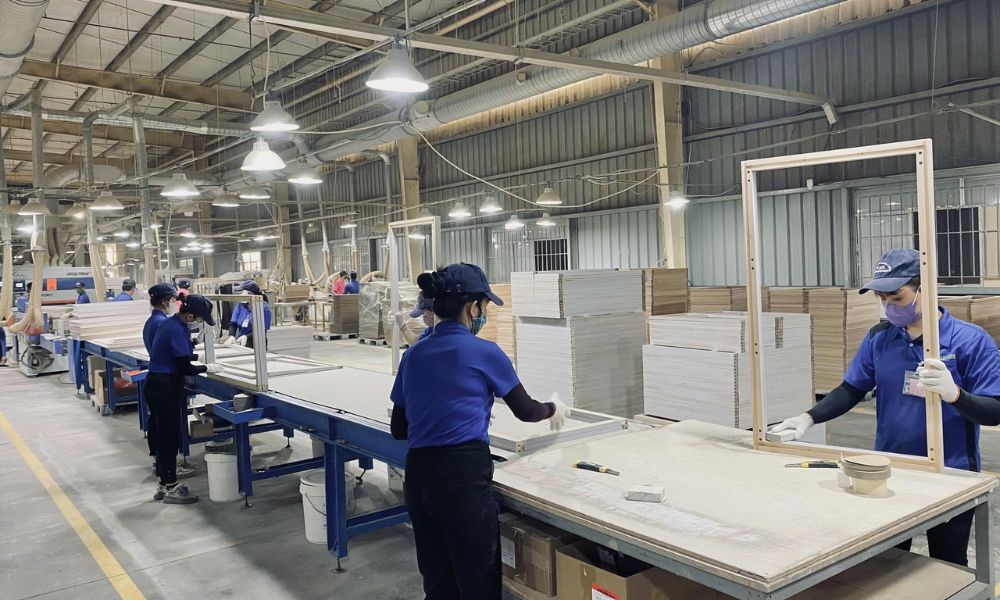
Efficient manufacturing helps maintain reliable production schedules.
The production phase of kitchen cabinet lead time Vietnam OEM factory schedules typically runs 25–38 days and breaks down as follows:
CNC cutting of all box components (sides, tops, bottoms, backs, shelves), edge banding application, and drilling for cam-lock hardware, shelf pins, and hinge mounting plates. At factories running Homag CNC equipment, this phase is highly consistent — ±0.5mm tolerance on all dimensions. Batch sizes matter here: a 1-container order runs through CNC faster than a 5-container order, but the proportional time difference is smaller than buyers expect because cutting is the fastest phase.
Door production runs parallel to box processing but takes longer: stile and rail profiling, center panel machining, assembly, sanding, and primer application. For painted doors, this phase includes 3-coat UV or spray lacquer application with mandatory drying time between coats — this is the most time-sensitive phase and the primary source of schedule variation. Humidity and temperature affect drying time; Vietnam’s rainy season (May–October) can add 1–3 days to finish cure times.
Box assembly, face frame attachment (for framed programs), drawer box installation, hinge mounting, and soft-close adjustment. This phase is labor-intensive but predictable — experienced assembly teams maintain consistent daily output rates.
Final QC inspection: dimensional verification, finish inspection under raking light, hardware function testing (50-cycle drawer and hinge test), and CARB labeling verification. Defect rates at this stage determine whether the schedule holds or slips — factories with in-line QC (catching defects during production rather than at final inspection) consistently ship closer to their quoted lead times.
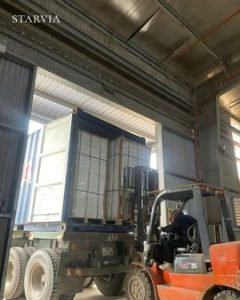
Individual carton packaging with foam corner protection, stretch-wrap of door panels, barcode labeling, packing list generation, and container stuffing. Container loading at the factory takes 1–2 days for a standard 40-foot container.
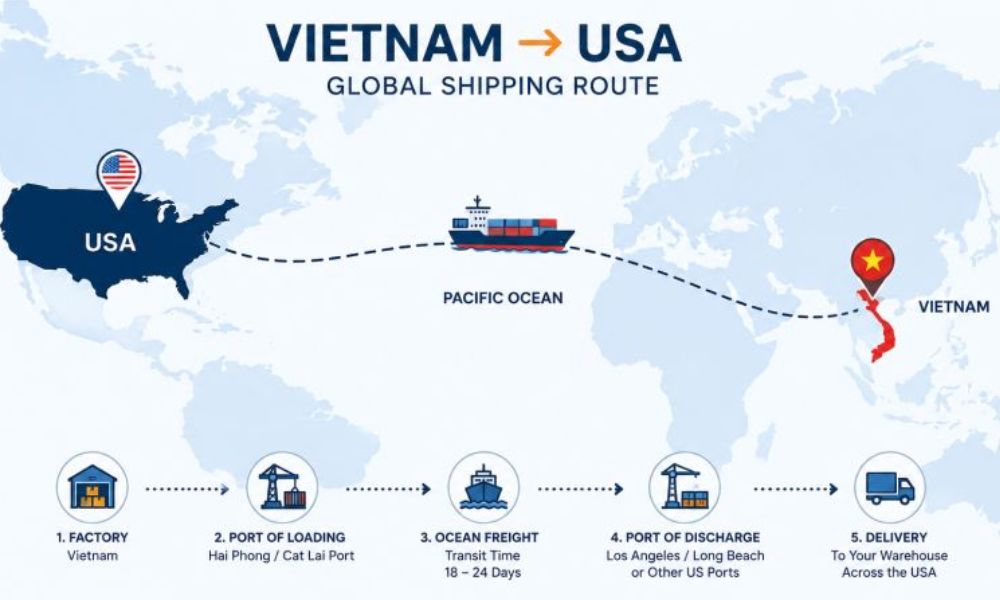
Typical ocean transit routes from Vietnam to major US ports.
Transit time is fixed by shipping line schedules and routing — it does not vary based on factory performance. Current benchmarks for kitchen cabinet lead time Vietnam OEM factory to destination port:
| Route (FOB Hai Phong) | Transit Time | Major Carriers |
|---|---|---|
| → Los Angeles / Long Beach | 18–22 days | Evergreen, ONE, Cosco |
| → New York / Savannah / Norfolk | 28–32 days | Maersk, MSC, CMA CGM |
| → Vancouver / Prince Rupert | 16–20 days | Evergreen, Yang Ming |
| → Melbourne / Sydney | 14–18 days | MSC, ONE, PIL |
| → Hamburg / Rotterdam | 24–28 days | Maersk, Hapag-Lloyd |
Current ocean freight rates (Q2 2026): West Coast approximately $3,200/FEU, East Coast approximately $5,000/FEU. For current rate benchmarks, Freightos provides real-time freight rate indices by route.
Add 3–7 days after vessel arrival for port processing, customs clearance (ISF filing, CBP release), and drayage to your warehouse — particularly at congested West Coast ports during peak season (August–November).
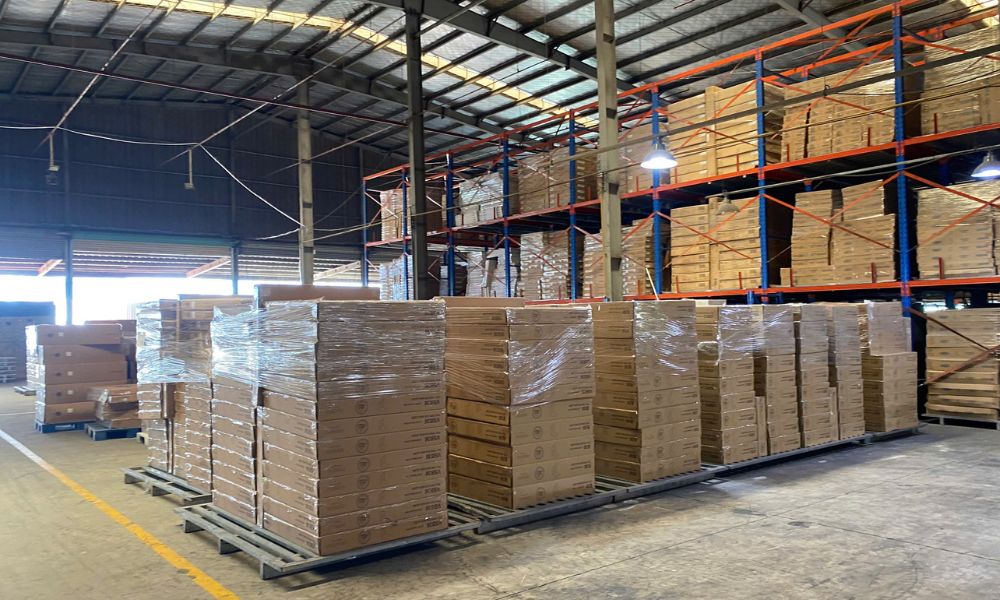
Typical ocean shipping routes from Hai Phong Port to major international markets.
The following factors are the most common causes of kitchen cabinet lead time Vietnam OEM factory overruns — understanding them lets buyers build realistic buffers into their planning calendars:
Any specification outside the factory’s standard catalog adds procurement and setup time: new wood species, new hardware brands, new finish colors requiring color development and approval, non-standard box dimensions, or new door profiles requiring router bit fabrication. Budget an additional 7–14 days for any specification that requires a new material or tooling purchase.
For new programs, production typically does not begin until the buyer approves a production sample. Each sample round adds 10–15 days: factory produces sample (5–7 days), ships to buyer (3–5 days air freight), buyer reviews and responds (2–5 days). Reducing sample rounds through precise written specifications upfront is the single highest-leverage action buyers can take to compress total program lead time.
Vietnam cabinet factories with consistent export programs often have 4–8 week production queues during peak season (February–May, August–October). Order placement timing relative to factory capacity significantly affects actual production start dates — not just quoted lead times. Confirm production start date (not just quoted lead time) at order placement.
Tết Nguyên Đán (Vietnamese Lunar New Year) typically falls in January–February and effectively shuts production for 10–14 days before and after the holiday. Factories also observe National Day (September 2) and other public holidays. Orders placed in December for January delivery are at high risk — build a 3-week buffer around Tết.
Vietnam’s northern rainy season (May–September) adds humidity that extends lacquer and UV-coat drying times. Well-equipped factories with climate-controlled spray booths mitigate this — verify booth conditions during factory qualification.
Professional importers sourcing from a kitchen cabinet lead time Vietnam OEM factory program use backward scheduling from the project delivery date:
For a US West Coast delivery needed by October 15: work backward → warehouse October 15 → customs/dray by October 10 → vessel arrival by October 5 → vessel departure ~September 14 (21-day transit) → loading by September 12 → production complete by ~September 7 → production start by ~August 1 → PO placement by July 25. If today is July 13 and you haven’t placed the order, you are already at risk for this timeline.
The National Association of Home Builders (NAHB) notes that supply chain lead time management is now a top operational challenge for US builders — importers who build systematic backward scheduling into their procurement process maintain a consistent competitive advantage over those who plan reactively.
Starvia’s standard kitchen cabinet lead time Vietnam OEM factory commitments for wholesale buyers:
Starvia’s Vietnam OEM production facilities run approximately 150 containers per month with ~1,000 production staff and Homag CNC equipment. Production calendar visibility (available slots) is provided to buyers placing repeat orders — contact our export team at starvia.com.vn/contact to discuss scheduling for your next program.
Standard production lead time from a kitchen cabinet lead time Vietnam OEM factory running catalog specifications is 35–45 days from confirmed purchase order and deposit receipt. New programs with non-standard specifications, new finish development, or sample approval rounds add 10–20 days. Always confirm the production start date in writing at order placement — not just the quoted lead time.
No — factory-quoted lead time covers production only, up to FOB Hai Phong. Ocean transit adds 18–22 days to the US West Coast and 28–32 days to the East Coast. Total order-to-US-port-arrival cycle is typically 55–75 days for standard programs.
Place orders for January–March delivery by late October to avoid Tết production shutdowns. Factories typically slow intake of new orders in November–December as they clear existing queues before the holiday. Orders placed in December for February delivery are at significant risk — build a 3-week buffer or plan delivery for April onwards.
Limited compression is possible by prioritizing an order in the production queue (subject to factory availability) or using air freight for small quantities of critical SKUs. Air freight from Vietnam to the US runs approximately $4–$6/kg — viable for door sets or hardware, not practical for full cabinet containers. The most reliable way to manage urgent timelines is systematic backward scheduling, not rush production.
A third-party PSI (SGS, Bureau Veritas, Intertek) typically adds 2–3 days to the schedule — inspection booking, inspection day, and report issuance. PSI should be coordinated at order placement and scheduled for 2–3 days before planned loading. Attempting to book PSI after production completes often delays loading by a week due to inspector availability.
Every successful Vietnam cabinet import program starts with an accurate kitchen cabinet lead time Vietnam OEM factory model built into the procurement calendar. Starvia provides written production start confirmations, proactive shipping documentation, and production calendar visibility for repeat buyers.
Contact our export team to discuss scheduling for your next container at starvia.com.vn/contact.



 View collection
 View collection
 View collection
 View collection