- Our Products
-
Choose your Cabinet Style
-

Getting kitchen cabinet shelf load rating wholesale OEM specifications right determines whether a kitchen shelf holds a stack of dinner plates for twenty years or sags visibly within the first one. Shelf load capacity is not a single number — it is a function of core material, thickness, and unsupported span together. Buyers who specify material without specifying span are leaving the actual load rating undefined.
A shelf’s load rating is only meaningful alongside its span, because the same panel that comfortably carries 50 pounds per square foot (psf) at a 24-inch span can fail to meet deflection limits at 48 inches under the identical load. Industry testing fixes a deflection limit — typically span/240 or span/360, meaning the shelf may not sag more than 1/240th or 1/360th of its own span under load — and then calculates the maximum span or load that stays within that limit.
A kitchen cabinet shelf load rating wholesale OEM factory that quotes a load capacity without stating the span and deflection limit it was tested against is giving buyers an incomplete number, not a verifiable specification.
Standard kitchen cabinet shelving is typically designed for 25 to 30 psf of uniform load — covering stacked dinnerware, canned goods, and small appliances — while dedicated bookshelf applications are designed for up to 50 psf, nearly double the kitchen baseline. This gap matters because a shelf specification copied from a general shelving guide without adjusting for actual kitchen use case can either under-spec a heavily loaded pantry shelf or over-spec a light upper cabinet unnecessarily.
A kitchen cabinet shelf load rating wholesale OEM buyer sourcing pantry or heavy-storage cabinets should specify the higher end of this range explicitly, rather than assuming a standard kitchen shelf spec covers a storage-heavy application.
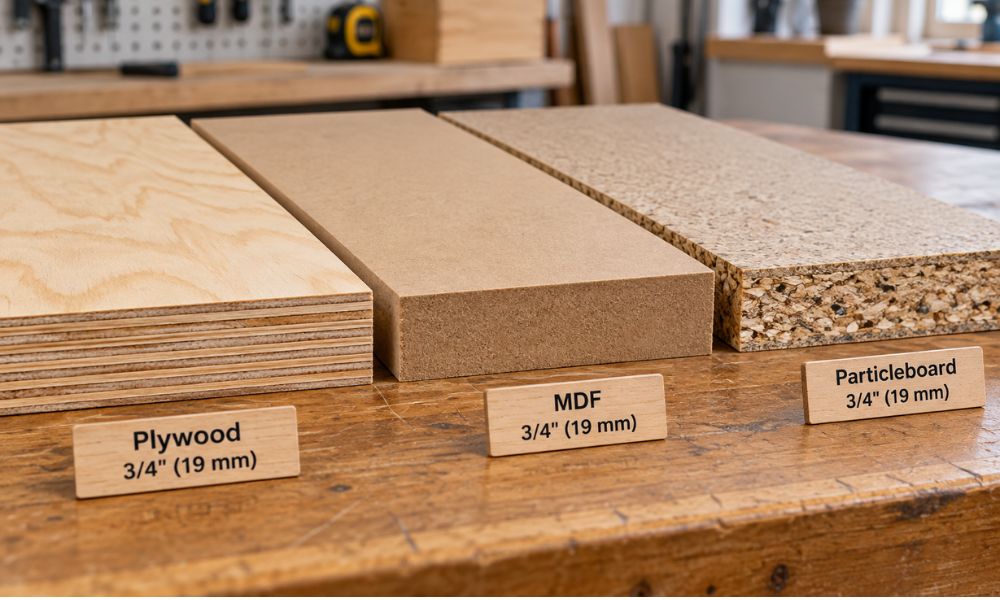
Shelf core material influences stiffness, span limits, and load performance.
Published span tables for engineered panel shelving give concrete numbers at a fixed 50 psf load and a span/240 deflection limit. At 3/4-inch thickness, single-span limits run from 18.0 inches for MDF 115 grade up to 23.6 inches for MDF 155 grade, with particleboard grades falling in between: PBU at 20.1 inches, M-2 at 21.1 inches, and M-3i at 22.7 inches. Multiple-span (continuously supported) shelving extends these limits meaningfully — MDF 155 reaches 31.6 inches in a multi-span configuration versus 23.6 inches single-span.
These figures come from span tables referenced by the Composite Panel Association‘s mechanical property standards for particleboard and MDF, and they define the real-world ceiling on how far a kitchen cabinet shelf load rating wholesale OEM factory can span an engineered panel shelf before deflection exceeds the standard limit.
| Material (3/4″, 50 psf, span/240) | Single Span | Multiple Span |
|---|---|---|
| MDF 115 | 18.0 in | 24.1 in |
| Particleboard PBU | 20.1 in | 26.9 in |
| Particleboard M-2 | 21.1 in | 28.3 in |
| MDF 130 | 21.6 in | 29.0 in |
| Particleboard M-3i | 22.7 in | 30.5 in |
| MDF 155 | 23.6 in | 31.6 in |
Plywood performs differently because it is tested as load-capacity-at-fixed-span rather than span-at-fixed-load, but the numbers translate directly. APA’s load-span data for 3/4-inch Group 1 sanded plywood shows a 48-inch span carrying 25 psf at a span/360 deflection limit, or up to 38 psf at the more permissive span/240 limit — both comfortably above the 25-30 psf kitchen cabinet baseline, at a span roughly double what 3/4-inch MDF or particleboard can hold to the same deflection standard.
At a 40-inch span, 3/4-inch plywood carries 39 psf at span/360, and slightly thinner 23/32-inch plywood carries 35 psf at the same span and deflection limit. This is the structural reason the plywood core material covered in our core material comparison is the standard choice for any shelf expected to span wider than roughly 24 inches without a center support.
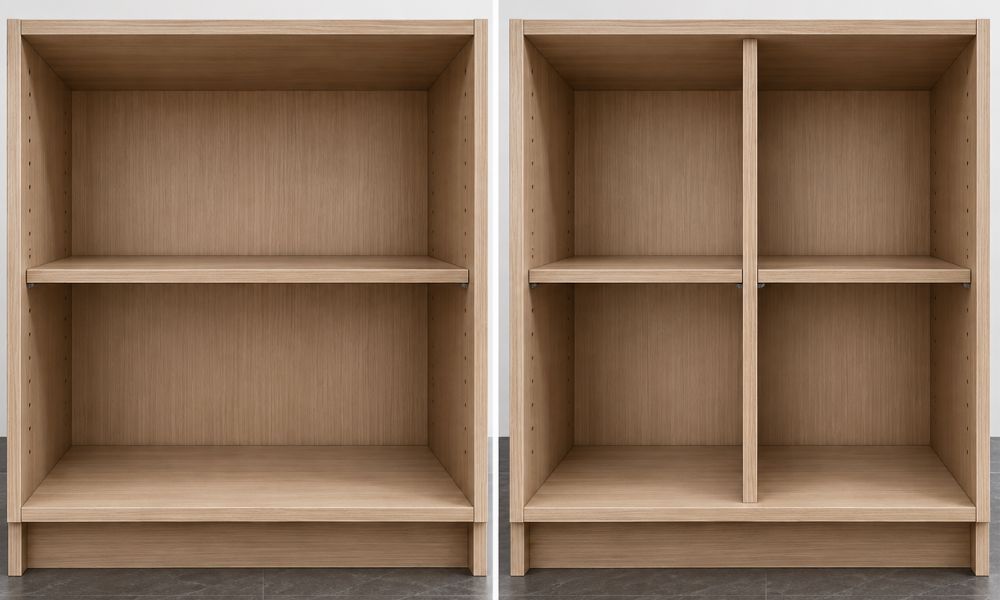
Adding center support reduces unsupported shelf span and helps control deflection.
A kitchen cabinet shelf load rating wholesale OEM factory building a 30-inch-wide upper cabinet with a particleboard shelf is already past the 20.1 to 22.7-inch single-span limit for most particleboard grades at 50 psf — meaning that shelf either needs a center support, a thicker panel, or a switch to plywood to meet standard deflection limits under a full load. The same 30-inch cabinet built with 3/4-inch plywood stays well within its rated span at typical kitchen loads.
This is why cabinet width — covered in detail in our standard sizing guide — is not just a layout decision but a structural one: every width increment beyond roughly two feet pushes shelf span closer to the limit of engineered panel materials and closer to requiring plywood or added support. Buyers specifying custom widths outside the standard increment table should flag shelf span explicitly in the purchase order rather than assuming the factory’s default shelf spec scales safely to a nonstandard opening.
Shelves 12 inches or less in depth with continuous rear support against the cabinet back panel can double their rated span compared to a shelf supported only at the two side ends, since the rear support acts as a third bearing line across the full shelf width. An overhang of up to 6 inches beyond the front or side support point can typically be added to the calculated span without exceeding deflection limits, which matters for shelves with a slight lip or decorative edge extending past the cabinet opening.
A kitchen cabinet shelf load rating wholesale OEM factory should apply these adjustments explicitly when calculating shelf spec for shallow upper cabinets, rather than defaulting to the more conservative two-point-support span limit on every shelf regardless of depth or rear attachment.
A span/360 deflection limit is stricter than span/240 — it allows less sag for the same span — which is why the same 3/4-inch plywood panel rates 25 psf at 48 inches under span/360 but 38 psf under span/240, a 52 percent swing in rated load from the deflection standard alone.
Buyers comparing load ratings from different suppliers should confirm which deflection limit each number assumes. A factory quoting the more permissive span/240 standard will show a materially higher load rating than one using span/360 for an otherwise identical shelf.
This same measurement discipline applies to the countertop load data in our countertop support guide, where deflection limit and support spacing together — not weight alone — determine whether a given span holds without visible sag.
Standard base and wall cabinets at typical 24 to 30-inch widths perform adequately with 3/4-inch particleboard or MDF shelving at the kitchen baseline load of 25-30 psf, provided the shelf stays within single-span limits for the chosen grade. Pantry cabinets, tall storage units, and any cabinet wider than roughly 30 inches benefit from plywood shelving or a center-supported design, since these applications routinely exceed either the load (canned goods, small appliances concentrated on one shelf) or the span limit of engineered panel shelving.
This component-level matching is the same discipline covered in our box construction guide: specify structural material by the actual demand on each component, not a single material standardized across every shelf in the kitchen regardless of width or expected load.

Sample shelf load testing helps verify deflection and structural performance before mass production.
Request a sample shelf built to your specified width, thickness, and support configuration, then test it directly with a known, evenly distributed load rather than relying on a supplier’s general spec sheet number alone. This is the same verification discipline applied during a quality control audit: confirm the actual installed and loaded performance, not a published average that may not reflect your specific cabinet width.
For multifamily and production-builder orders, a shelf load rating confirmed on one sample unit should be re-verified across the production run, since minor variation in panel density or edge banding application can shift the real-world load rating from unit to unit even when every shelf is nominally the same specification.
What load should a standard kitchen cabinet shelf be designed for? Typically 25 to 30 psf of uniform load for standard kitchen use, rising toward 50 psf for pantry or dedicated storage shelving carrying denser items like canned goods or small appliances.
Is plywood always necessary for cabinet shelving? No — 3/4-inch particleboard or MDF performs adequately within their single-span limits (roughly 18 to 23 inches at 50 psf), which covers most standard 24-inch cabinet widths; plywood becomes the better choice as width or load increases beyond those limits.
Why do two suppliers quote different load ratings for the same shelf material? The most common reason is a different deflection limit assumption — span/240 allows a meaningfully higher rated load than span/360 for the same panel and span, so the two numbers are not directly comparable without knowing which standard each used.
Does shelf depth affect load rating? Yes — shallower shelves (12 inches or less) with continuous rear support can carry a longer span at the same load than deeper shelves supported only at the side ends.
How much does cabinet width affect shelf load rating risk? Significantly — every few inches of additional width pushes an engineered panel shelf closer to its single-span deflection limit, which is why wide cabinets need either a center support, a thicker panel, or a switch to plywood.
Should I test shelf load rating myself before approving a production run? Yes, on at least one sample per shelf width and material combination — a loaded sample test catches span and deflection issues that a spec sheet number alone can miss.
Does edge banding or lipping affect the load rating? A solid front edge or nosing strip adds modest stiffness and can allow a slightly longer span than an unbanded panel of the same core material, though it does not substitute for the core thickness and span limits set by the base panel itself.
Starvia specifies kitchen cabinet shelf load rating wholesale OEM shelving by width, material, and deflection standard — particleboard and MDF within verified single-span limits, plywood for wider or heavier-load cabinets — with loaded sample shelves available for buyer verification before production starts. If your next order needs shelf span and load rating confirmed against your specific cabinet widths, talk to our production team before you approve samples and release your deposit.


 View collection
 View collection
 View collection
 View collection