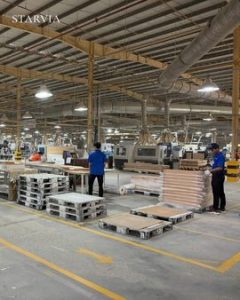
- Our Products
-
Choose your Cabinet Style
-

A complete kitchen cabinet import checklist Vietnam covers far more than freight cost. Between HTS classification, Section 232 duty exposure, and the paperwork a customs broker needs to clear a container at the port, first-time wholesale buyers routinely lose days — sometimes weeks — to documentation gaps that a checklist would have caught before the ship ever left Vietnam.
This kitchen cabinet import checklist Vietnam buyers can use walks through classification, required shipping documents, duty and tariff exposure, and the inspection steps that separate a clean customs clearance from a container held at port.
Before reviewing the import process, it’s worth understanding how to choose a reliable manufacturing partner. Learn more in our guide to Vietnam Kitchen Cabinet Manufacturer.
Before any paperwork is filed, confirm the Harmonized Tariff Schedule (HTS) code your cabinets fall under. Kitchen cabinets designed for permanent installation are generally classified under HTS code 9403.40.9060, which carries a general duty rate of roughly 0.5% ad valorem.
That low base rate is misleading. A Section 232 tariff currently adds an additional 25% duty on imported kitchen cabinets and vanities from Vietnam, with an increase to 50% scheduled for January 1, 2027 after a one-year delay.
Buyers should verify the current classification and duty exposure directly against the official Harmonized Tariff Schedule because product composition can affect the final classification.
Any kitchen cabinet import checklist Vietnam buyers build should start with this duty confirmation step, because it directly affects landed cost math before a purchase order is even signed.
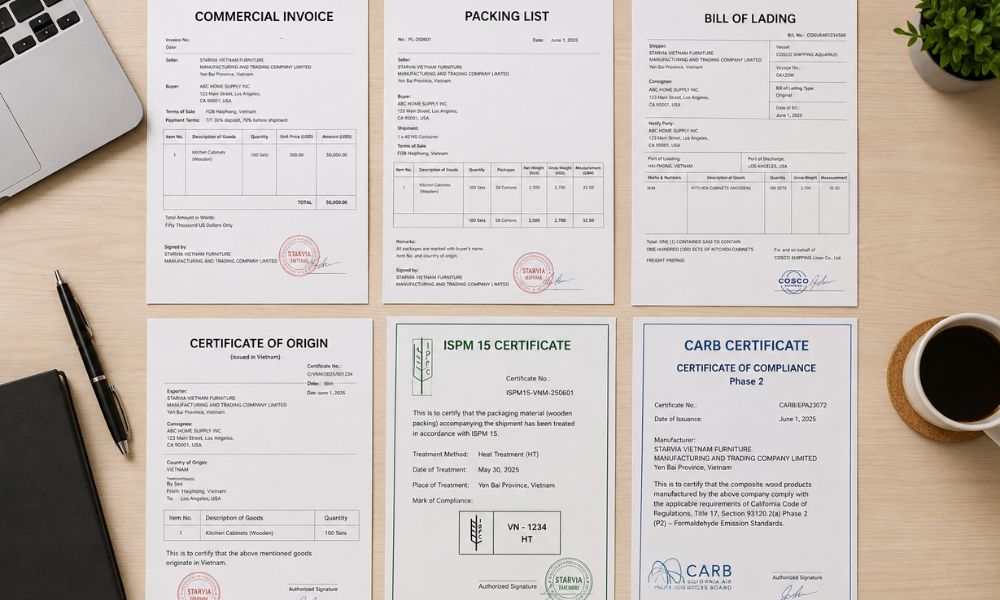
Every shipment should include complete documentation before the container leaves Vietnam.
A container will not clear US customs without a complete document set. The core items on a kitchen cabinet import checklist Vietnam buyers need before their goods arrive at port are:
Every item on this kitchen cabinet import checklist Vietnam buyers assemble should be cross-checked before the container departs, not after it arrives — corrections are far cheaper to make at origin than at a US port.
Most wholesale buyers importing kitchen cabinets from Vietnam ship full container load (FCL), since OEM factories typically set a minimum order quantity at one 40ft container. FCL shipments simplify the documentation side of a kitchen cabinet import checklist Vietnam buyers are working through, because the entire container belongs to a single commercial invoice and packing list. Less-than-container-load (LCL) shipments — sometimes used for smaller sample or top-up orders — add complexity, since goods are consolidated with other shippers’ cargo and the packing list must be reconciled against a shared bill of lading. Buyers testing a new factory relationship with a partial order should confirm with their freight forwarder how LCL consolidation affects clearance timing before assuming it will match FCL turnaround.
Beyond Section 232 tariffs, buyers should ask their customs broker to screen for anti-dumping and countervailing duty (AD/CVD) orders that may apply to specific wood products or components within a shipment.
AD/CVD exposure is typically tied to the country of origin of raw materials rather than the country of final assembly. A factory sourcing certain panel materials from outside Vietnam could therefore create AD/CVD exposure even on a Vietnam-assembled cabinet. This is a detail that is easy to miss on a basic kitchen cabinet import checklist Vietnam template, so it should be reviewed before the purchase order is finalized.
Most wholesale buyers importing a full container of kitchen cabinets for the first time benefit from a licensed customs broker rather than attempting self-filing. A broker will verify the correct 10-digit HTS code for your specific product mix, confirm AD/CVD exposure, calculate the landed duty accurately, and file the entry with US Customs and Border Protection on your behalf. According to US Customs and Border Protection (CBP), duty rates are determined by classification, valuation, and country of origin together — a combination that is easy to get wrong without broker guidance on a first shipment.
Buyers running a private label or OEM program should ask prospective brokers directly whether they have handled Section 232-affected furniture and cabinetry entries, since the tariff layering on top of standard HTS duty is a relatively recent complication that not every broker has experience with yet.
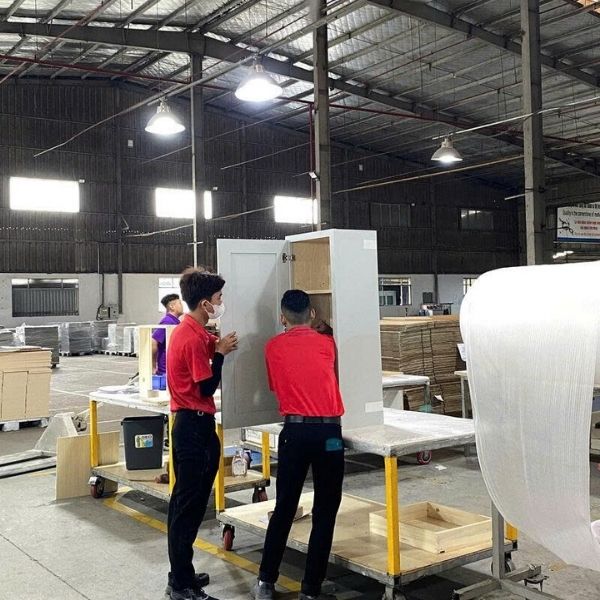
Pre-shipment inspection helps identify quality issues before export.
Documentation only solves half the problem. The other half is confirming the physical goods match what was ordered before the container leaves the factory. A pre-shipment inspection — either conducted in-house or through a third-party inspection service — should verify:
Skipping this step is one of the most expensive mistakes on any kitchen cabinet import checklist Vietnam buyers should be following, since a discrepancy discovered after ocean transit is far costlier to resolve than one caught at the factory gate.
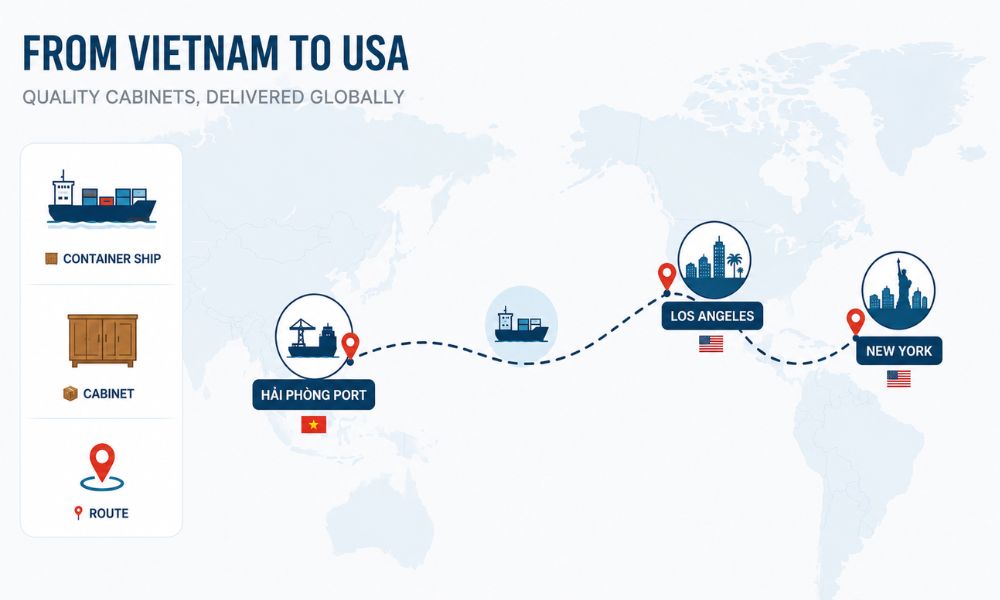
Typical ocean transit time for cabinet shipments from Vietnam to major US ports.
Ocean transit from Vietnam to the US West Coast (Los Angeles/Long Beach) typically runs 18–22 days, while East Coast ports run 28–32 days. Buyers should build customs clearance time — commonly 3–7 business days once the vessel arrives, assuming documentation is complete — into their inventory planning. Current container freight rates fluctuate significantly by lane and season; tools like Freightos provide indicative spot pricing that helps buyers budget landed cost before committing to a purchase order.
Housing market conditions are also worth tracking when planning import volume. The National Association of Home Builders (NAHB) Housing Market Index and monthly US housing starts data both give wholesale buyers a demand signal for remodel- and new-construction-driven cabinet orders over the months a shipment will be in transit and clearing customs.
Mismatched invoice and packing list values. Even small discrepancies between the commercial invoice and packing list are a common trigger for a customs hold and manual review.
Missing or incomplete ISPM15 fumigation stamps. Wood packaging without proper fumigation marking can be rejected or require costly re-treatment at port.
Underestimating Section 232 duty exposure. Buyers who price a purchase order off the base 0.5% HTS duty rate alone, without factoring the additional 25% Section 232 tariff on cabinets and vanities, frequently miscalculate landed cost by a wide margin.
No formaldehyde emission documentation on file. Shipments bound for California in particular can face additional scrutiny without CARB Phase 2 or equivalent certification readily available.
Choosing a broker with no furniture/cabinetry experience. HTS classification for cabinets has enough nuance (material composition, whether hardware is included, assembly state) that broker familiarity with the product category meaningfully reduces clearance risk.
For buyers setting up a repeatable process, a simple pre-departure checklist should confirm: HTS code and duty rate verified, commercial invoice and packing list cross-checked line by line, certificate of origin issued, ISPM15 fumigation certificate attached, CARB or equivalent compliance documentation on file, customs broker briefed on Section 232 exposure, and pre-shipment inspection completed and signed off. Buyers who formalize this into a standing kitchen cabinet import checklist Vietnam document — reused for every purchase order — consistently report fewer clearance delays than buyers who recreate the process from memory each time.
Buyers who treat customs clearance as a documentation exercise rather than a logistics afterthought consistently see shorter port dwell times and fewer demurrage charges. The FAQ below covers the questions that come up most often once a purchase order has shipped.
Kitchen cabinets designed for permanent installation generally fall under HTS 9403.40.9060, though buyers should confirm classification against their specific product composition with a licensed customs broker.
The general HTS duty rate is around 0.5%, but a Section 232 tariff currently adds 25% on imported kitchen cabinets and vanities, with an increase to 50% scheduled for January 1, 2027.
It is not legally required for all shipments, but most first-time wholesale buyers benefit significantly from broker guidance on classification, AD/CVD screening, and entry filing.
Mismatches between the commercial invoice and packing list, along with missing ISPM15 fumigation certification on wood packaging, are among the most common causes of a customs hold.
Typically 3–7 business days with complete documentation, though incomplete paperwork or a compliance flag can extend this considerably.
Formaldehyde emission standards apply nationally under EPA TSCA Title VI rules, but California’s CARB Phase 2 program is enforced with particular rigor, making documentation especially important for California-bound shipments.
Cargo insurance is optional but strongly recommended. FOB terms typically shift risk to the buyer once goods are loaded at the origin port, so marine cargo insurance covering the full transit period protects against damage, water intrusion, or loss that basic carrier liability limits would not fully cover.
A template can be reused, but each shipment’s commercial invoice, packing list, and certificate of origin still need to be generated fresh and verified individually — an established factory relationship reduces risk but does not eliminate the need to check every document on each container.
A reliable kitchen cabinet import checklist Vietnam process starts upstream, at the factory. Suppliers that already hold CARB Phase 2 certification, maintain documented production tolerances, and are experienced shipping to North America, Australia, and Europe tend to generate cleaner paperwork and fewer surprises at customs — which is ultimately what protects a wholesale buyer’s delivery timeline and margin.



 View collection
 View collection
 View collection
 View collection