- Our Products
-
Choose your Cabinet Style
-

Getting kitchen cabinet countertop support wholesale OEM specifications right matters most on the cabinets your installer never sees twice: the box has to carry a countertop that can weigh eight times more than the lightest material on the market, without sagging, flexing, or stressing the hinge and slide hardware mounted into the same box sides. Natural stone, quartz, laminate, and butcher block each place a different load on the cabinet beneath them.
A factory that specifies box reinforcement the same way for every countertop type is either over-building the light jobs or under-building the heavy ones, and buyers rarely find out which until years into ownership.
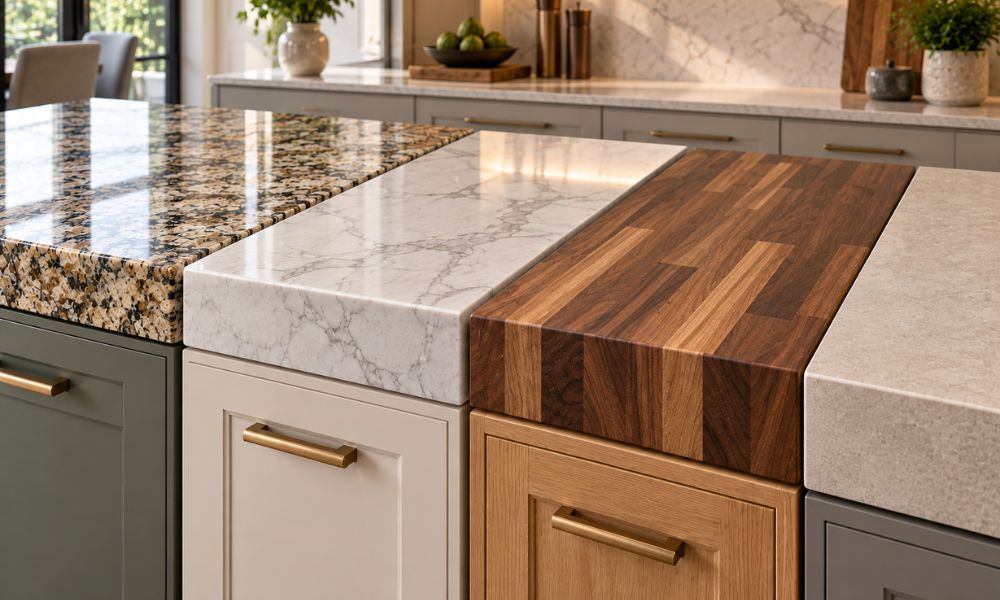
Granite, quartz, butcher block and laminate place very different loads on the cabinet box below.
Countertop weight varies more than most buyers expect: a 3cm natural stone or quartz slab runs approximately 16 to 17.6 lb per square foot, while laminate runs only 1.5 to 2 lb per square foot, and butcher block falls in between at roughly 3 to 5 lb per square foot depending on species and thickness. That is close to a 15 lb per square foot gap between the heaviest and lightest common countertop materials.
This gap is the single biggest variable in how much structural support the cabinet box underneath needs to provide, more than any other single specification decision in the order.
A kitchen cabinet countertop support wholesale OEM factory that treats every cabinet box the same regardless of the countertop material going on top is not accounting for this gap, and buyers should ask directly which reinforcement level applies to their specific countertop choice.
| Countertop Material | Weight per Sq Ft | Relative Load |
|---|---|---|
| Granite / Marble (3cm) | 16.1-17.6 lb | Heaviest — full box support required |
| Engineered Quartz (3cm) | 16.1-17.1 lb | Heaviest — full box support required |
| Natural Stone (2cm) | ~11 lb | High — standard support, verify edge build-up |
| Butcher Block | 3-5 lb | Moderate |
| Laminate | 1.5-2 lb | Lightest — standard box construction sufficient |
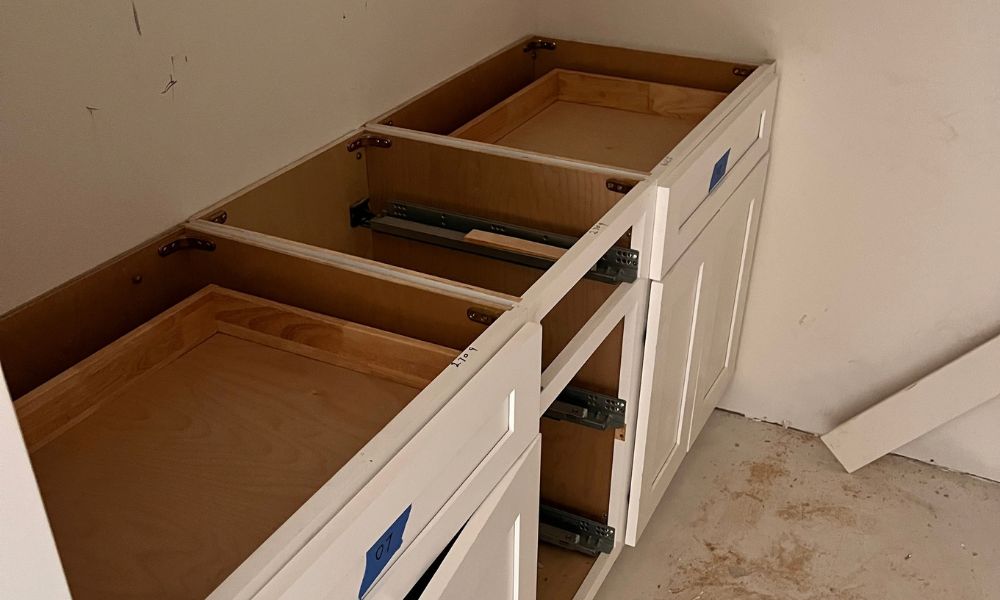
Reinforced stretcher rails and corner support help the cabinet box distribute heavy stone and quartz countertop loads.
At 16 to 17.6 lb per square foot, a typical 25-square-foot kitchen countertop run in granite or quartz places 400 to 440 lb of static load across the base cabinet run, concentrated most heavily at seams, sink cutouts, and any unsupported overhang. A kitchen cabinet countertop support wholesale OEM factory should specify continuous full-depth corner blocks, reinforced stretcher rails at the top of every base cabinet box, and additional bracing under any run carrying a sink cutout, where removed material reduces the stone’s own structural contribution.
This reinforcement is also why core material choice interacts directly with countertop weight: the plywood-core cabinet boxes covered in our core material comparison hold screws and distributed load more reliably under heavy stone than particleboard-core equivalents, making plywood the stronger default under any countertop above roughly 10 lb per square foot.
Unsupported stone overhangs are capped at roughly one-third of the total countertop dimension, not to exceed 15 inches, regardless of 2cm or 3cm thickness, per standard fabrication guidance used across the solid surface and stone industries. Steel supports extend a safe overhang to 24 inches per support point, with support centers spaced no more than 36 inches apart, and any overhang beyond 24 inches requires substrate backing or posts at the same 36-inch spacing.
These limits apply to the countertop fabricator’s install, but the cabinet box underneath still has to anchor those support brackets securely — a kitchen cabinet countertop support wholesale OEM factory should confirm its box construction accepts bracket mounting hardware at the fabricator’s specified points, not just at standard stud-equivalent locations convenient for the cabinet maker. Fabrication standards for solid surface and laminate overhangs are documented by the International Surface Fabricators Association, a useful reference when coordinating overhang support between your cabinet factory and countertop installer.
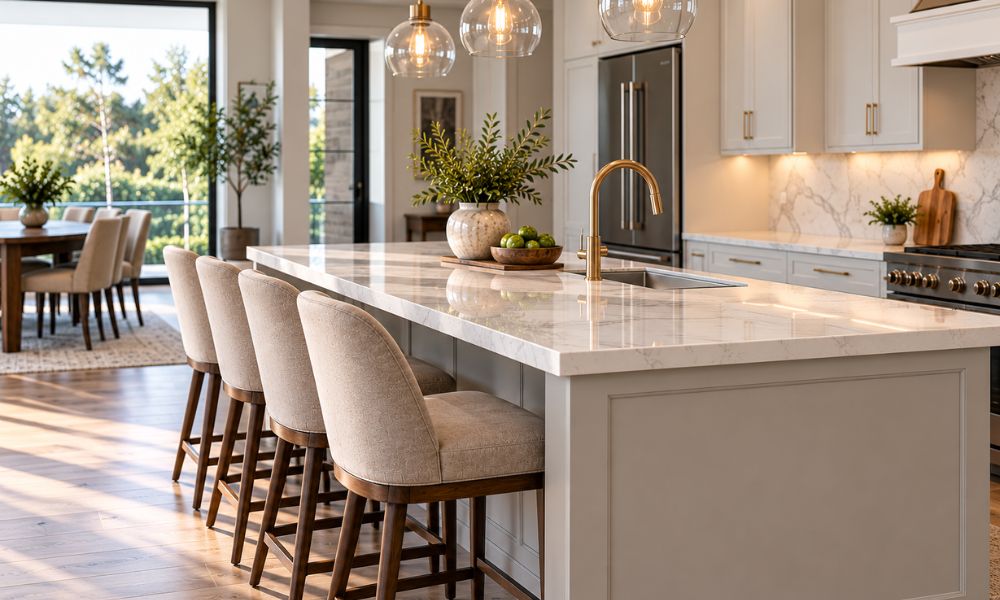
Island seating overhangs may require steel brackets anchored securely into the cabinet structure.
Kitchen islands and peninsulas carry the highest overhang risk because seating overhangs commonly exceed the 15-inch unsupported limit by design, requiring steel brackets or a full knee-wall structure the cabinet box must accommodate. Buyers specifying an island with a seating overhang should confirm bracket attachment points with both the countertop fabricator and the cabinet factory before cabinet production starts, since retrofitting bracket mounting into an already-built box is far more disruptive than specifying it upfront.
This coordination connects directly to the dimensional planning in our standard sizing guide, since island cabinet depth and height both factor into how much overhang a given seating configuration can safely support.
Laminate’s 1.5 to 2 lb per square foot load means standard box construction comfortably supports it without additional reinforcement, but laminate’s failure point shifts to edge delamination and seam separation rather than structural sag. Screw-mounted substrate backing at seams still matters even though total weight is low.
Butcher block at 3 to 5 lb per square foot carries moderate load but expands and contracts with humidity more than any engineered countertop material, requiring expansion gaps at the cabinet attachment points. A kitchen cabinet countertop support wholesale OEM factory should build this allowance into its standard specification rather than treating it as an afterthought.
Cabinet-level structural performance, including load-bearing capacity under sustained weight, falls under testing standards maintained by KCMA (Kitchen Cabinet Manufacturers Association), whose A161.1 performance standard evaluates cabinet durability under conditions that include static and cyclic loading relevant to countertop weight. A factory that maintains KCMA A161.1 compliance has already demonstrated its boxes hold up under standardized load testing, which is a useful proxy when evaluating whether a supplier’s standard construction can carry a specific countertop material without custom reinforcement.
This certification does not replace a direct conversation about your specific countertop weight and reinforcement needs, but a kitchen cabinet countertop support wholesale OEM factory that references KCMA A161.1 in its documentation is signaling the same structural discipline buyers should expect when specifying heavier stone or quartz countertops.
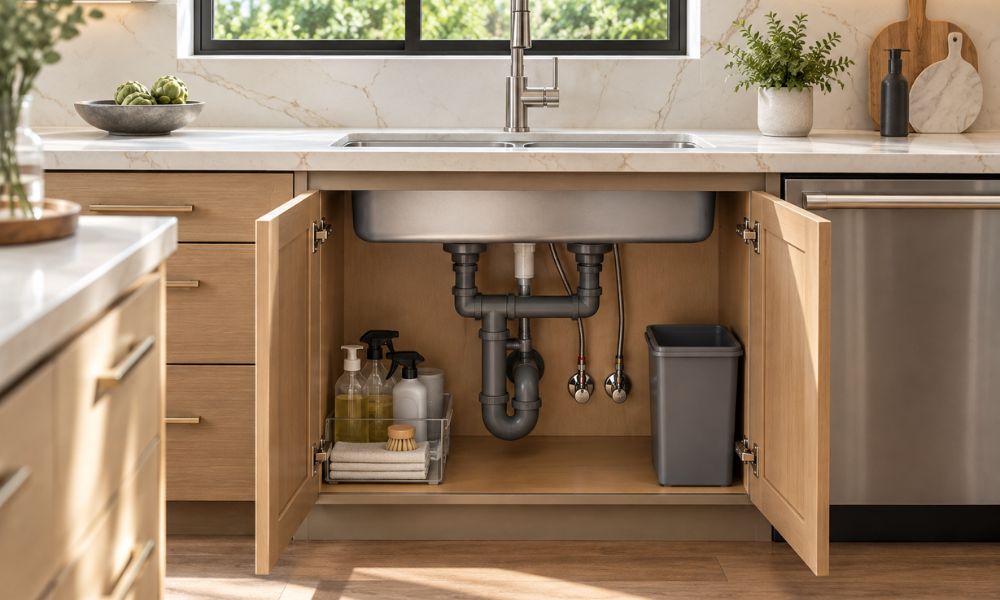
Additional bracing around sink bases helps support countertop areas weakened by sink cutouts.
Every countertop material loses structural integrity at a sink cutout, but stone and quartz lose the most in absolute terms because the removed material represents a meaningful share of the slab’s own load-bearing contribution at that point. Specify additional cross-bracing directly beneath any sink cutout regardless of countertop material, and confirm with your factory that this bracing is standard on sink base cabinets rather than an upgrade option buried in a separate line item.
This is the same documentation discipline that applies during a quality control audit: verify the specific reinforcement detail on the actual cabinet, not just a general claim that “all sink bases are reinforced.”
Buyers coordinating cabinets and countertops from separate suppliers should lock in four items before cabinet production starts: confirmed countertop material and weight per square foot, confirmed overhang distances for any island or peninsula, confirmed bracket or support mounting points shared between both suppliers, and confirmed sink cutout reinforcement on every affected cabinet. Skipping this coordination is the most common reason a countertop installer discovers a mismatch — insufficient bracket backing, misaligned support points — on install day rather than during planning.
For multifamily and production-builder projects, this coordination gap multiplies across every identical unit, making upfront specification far cheaper than a building-wide retrofit discovered after move-in.
Reinforced box construction for heavy stone or quartz countertops typically adds a modest per-unit cost over standard box construction, since the additional material is limited to corner blocks and stretcher rails rather than a full redesign. Lead time is generally unaffected as long as the reinforcement level is specified at the time of order — the cost and schedule risk comes from discovering mid-production that a buyer’s countertop choice needs heavier reinforcement than the standard spec the factory assumed by default.
Confirm reinforcement level in writing on your purchase order alongside the broader box construction specification, referencing the countertop material and weight explicitly rather than a generic “heavy-duty” designation that has no fixed numeric definition across suppliers.
Do all cabinet boxes need extra reinforcement under granite or quartz? Most well-built standard base cabinet boxes handle typical countertop loads adequately, but sink cutouts, island overhangs, and long unsupported runs benefit from the additional bracing described above regardless of how sturdy the base box already is.
Is laminate countertop weight ever a structural concern? Rarely — at 1.5 to 2 lb per square foot, laminate places minimal load on the cabinet box, and the more common laminate issue is edge delamination or seam failure rather than box sag.
How much overhang can a kitchen island have without extra support? Up to roughly one-third of the countertop’s total dimension or 15 inches, whichever is smaller, without added support; anything beyond that needs steel brackets or substrate backing per standard fabrication guidance.
Does core material matter for countertop support, or just box design? Both matter — a plywood-core box with proper bracing outperforms a particleboard-core box of identical design under the same heavy countertop, since core material affects how well the box itself resists sag and flex under sustained load.
Who is responsible for confirming bracket mounting points — the cabinet factory or the countertop fabricator? Both, ideally in direct coordination before cabinet production starts; relying on either party to guess the other’s requirements is the most common source of install-day mismatches.
Does butcher block need different cabinet attachment than engineered countertops? Yes — butcher block expands and contracts with humidity, so attachment points need expansion allowance that engineered stone and laminate do not require.
Does a KCMA-certified factory automatically provide adequate countertop support? Not automatically — KCMA A161.1 certification confirms a factory’s boxes pass standardized structural testing, but buyers should still confirm reinforcement specifics for their particular countertop material and weight rather than assuming certification covers every scenario.
Starvia builds kitchen cabinet countertop support wholesale OEM box reinforcement by countertop material and weight — standard bracing for laminate and butcher block, reinforced corner blocks and stretcher rails for stone and quartz — with specification documentation available for buyer review before production starts. If your next order pairs cabinets with a specific countertop material, talk to our production team about reinforcement specs before you approve samples and release your deposit.
 View collection
 View collection
 View collection
 View collection