- Our Products
-
Choose your Cabinet Style
-

Choosing the right kitchen cabinet core material wholesale OEM is a structural decision with cost, weight, and durability consequences that show up years after the container clears customs, not on the sample you approved. Plywood, MDF, particleboard, and solid wood each behave differently under screws, humidity, and sustained load, and a factory that defaults to one core across every component without explaining why is leaving performance on the table.
Core material sits behind the finish, so buyers often treat it as a line-item detail rather than a specification worth negotiating. In practice, core choice determines how well a cabinet holds screws at hinge and slide mounting points, how it responds to humidity swings in transit and in the finished kitchen, and how much weight a shelf or drawer bottom can carry without sagging over time.
A disciplined kitchen cabinet core material wholesale OEM supplier assigns different cores to different components deliberately: structural boxes, flat door panels, and shelving each have different mechanical demands, and the best factories do not use one material everywhere by default.
Plywood: Density, Screw Holding, and Moisture Behavior
Plywood weighs approximately 2.1 to 2.3 lb per square foot at 3/4-inch thickness, the lightest of the four common core options, and its cross-laminated veneer layers give it dimensional stability in both directions. This cross-grain construction is also why plywood delivers the strongest screw holding of any core material, particularly at panel edges where hinges and slide hardware are mounted.
When plywood gets wet, it swells but largely returns to its original dimension as it dries, a recoverable response that particleboard and MDF do not share. Plywood intended for structural use is manufactured to APA — The Engineered Wood Association performance standards, which buyers can reference directly when specifying panel grade in a kitchen cabinet core material wholesale OEM purchase order.
MDF runs roughly 3 lb per square foot at 3/4-inch thickness, making it the heaviest of the four core options, with a typical density range of 600 to 800 kg/m³. Standard MDF composition is approximately 82% wood fiber, 9% urea-formaldehyde resin, 8% water, and 1% paraffin wax, bonded under heat and pressure into a uniform panel with no knots, voids, or grain pattern.
That uniformity is MDF’s strength for flat, profiled door fronts and painted surfaces, since it machines and routes cleanly without tear-out. It is also MDF’s weakness structurally: MDF has the weakest edge screw holding of the four core materials, and it swells permanently when wet, wicking water quickly through an unsealed edge. Mechanical and emission properties for MDF intended for interior cabinet use are defined under standards maintained by the Composite Panel Association.
Particleboard sits between plywood and MDF on weight, typically around 2.8 to 3.0 lb per square foot at 3/4-inch thickness, made from wood particles and resin pressed into a flatter, void-free panel compared to plywood’s layered construction. Edge screw retention is poor on particleboard, meaning fasteners driven into a raw panel edge strip out more easily than on plywood, which matters directly for hinge-mounting durability over years of daily use.
Particleboard’s moisture response is the least forgiving of the three engineered options: thickness swell from water exposure is permanent, because soaked particles expand and cannot recompress once dry. A kitchen cabinet core material wholesale OEM factory should reserve particleboard for melamine-laminated interior panels and moderate-span shelving, not sink base cabinets or any component likely to see direct moisture contact.
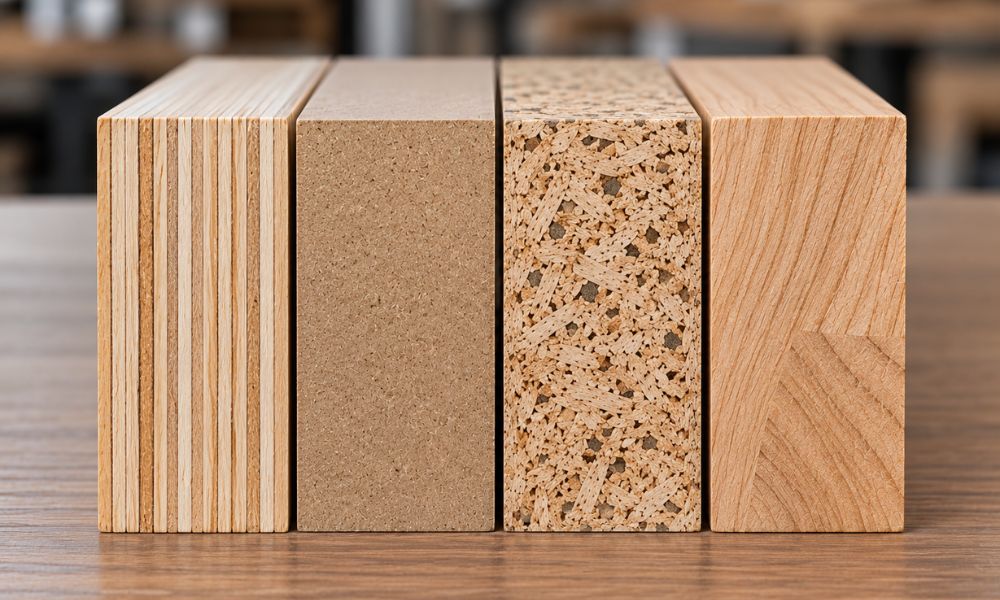
The internal structure of each core material affects weight, screw holding, moisture behavior, and its best cabinet application.
Solid wood is the only core material that moves seasonally — boards expand and contract across the grain in response to humidity changes, which is why solid wood panels are rarely used for large flat cabinet sides in OEM production. This same seasonal movement is manageable, and even desirable for appearance, in face frames, door frames, and trim pieces, where solid wood’s strength and natural grain remain the preferred choice across most OEM kitchen lines.
Buyers sourcing a kitchen cabinet core material wholesale OEM program should expect solid wood specifically in face frames and door components, engineered cores in box construction and flat panels, and should treat a quote offering solid wood box sides as either a premium custom option or a red flag for undisclosed cost cutting elsewhere in the build.
| Core Material | Weight (3/4″) | Screw Holding | Moisture Response | Best Use |
|---|---|---|---|---|
| Plywood | 2.1-2.3 lb/ft² | Strongest, especially at edges | Swells, recovers when dry | Boxes, sink bases, load-bearing shelves |
| Particleboard | 2.8-3.0 lb/ft² | Poor at edges | Permanent swell, not recoverable | Melamine interiors, moderate shelving |
| MDF | ~3.0 lb/ft² | Weakest of the four | Permanent swell, wicks water fast | Painted doors, profiled frames |
| Solid Wood | Varies by species | Strong along grain | Seasonal expansion/contraction | Face frames, door frames, trim |
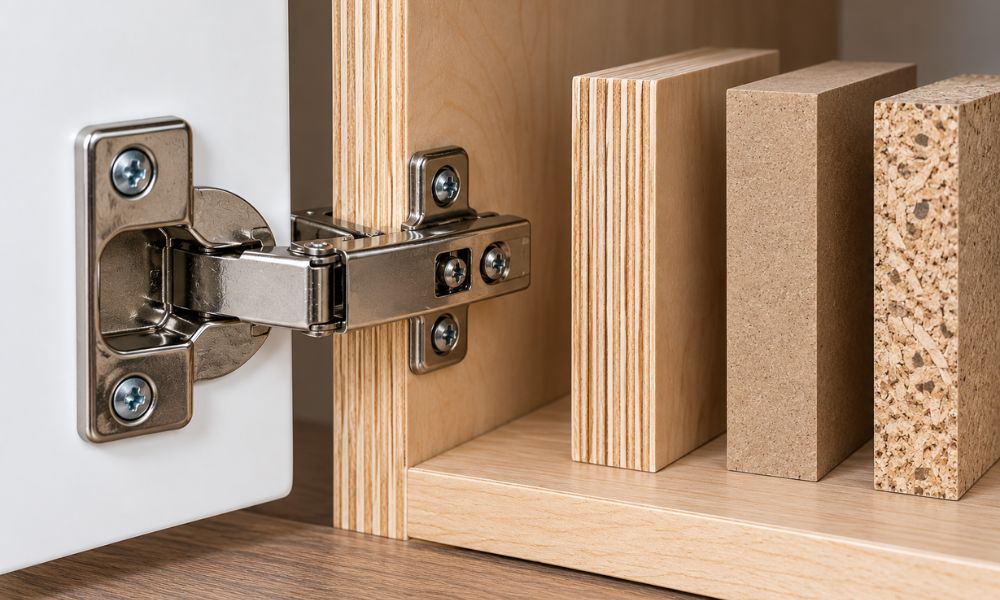
Core material selection directly affects screw retention at hinge and drawer-slide mounting points.
Every hinge, drawer slide, and shelf pin in a cabinet relies on the core material gripping a screw thread under repeated load, thousands of open-close cycles over the cabinet’s service life. Plywood’s layered grain structure resists screw pull-out in every direction, while MDF and particleboard rely entirely on resin-bonded fiber or particle friction, which fails faster under the same repeated stress, particularly at a panel edge rather than its face.
This is why many kitchen cabinet core material wholesale OEM factories build hinge-mounting cabinet sides from plywood even when door fronts use MDF for its paintable surface — matching the core to the mechanical demand of that specific component rather than standardizing on one material for cost simplicity.
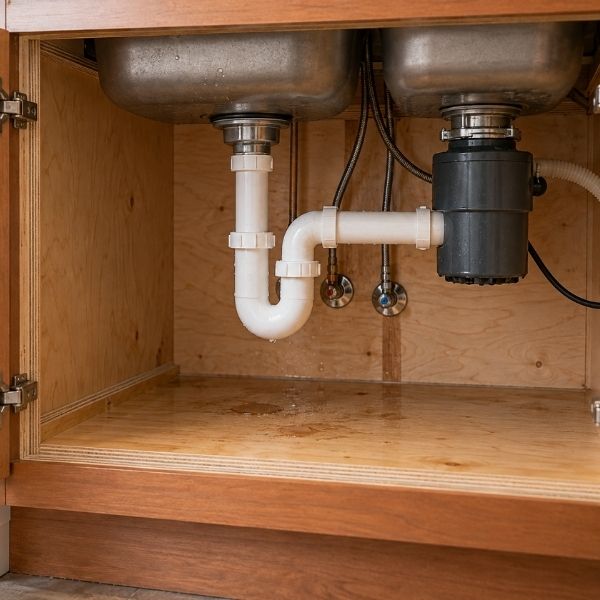
Moisture-exposed cabinet components require a core material selected specifically for the application.
Cabinets shipped from Vietnam travel through variable humidity during ocean freight and land in US climates ranging from arid to coastal-humid, so moisture response is not a theoretical property. A sink base or dishwasher-adjacent cabinet built with MDF or particleboard risks permanent swelling from the first plumbing leak, while the same cabinet built with plywood is far more likely to dry out and return to its original dimension.
Specify plywood explicitly for sink bases, dishwasher cabinets, and any component within direct splash range of water, and treat a factory’s silent substitution of particleboard or MDF in these locations as a quality control failure worth flagging during your next quality control audit.
Particleboard is typically the lowest-cost core, MDF runs a moderate premium for its paintable surface quality, and plywood commands the highest per-sheet cost among the three engineered options, though the gap is a modest percentage of total cabinet cost at OEM container volumes rather than a dramatic swing. Solid wood costs more per board foot than any engineered panel but is used in limited quantities for frames and trim, keeping its total impact on a full kitchen order manageable.
Lead time is rarely affected by core material choice itself, since all four materials are standard stock items for an established kitchen cabinet core material wholesale OEM factory — the exception is a buyer requesting solid wood box construction throughout, which shifts the order into custom engineering territory with the cost and lead time penalty that implies.
Rather than specifying one core material for an entire kitchen, buyers get better long-term performance by matching material to component: plywood for cabinet boxes and any surface near moisture, MDF for painted door fronts and profiled trim where its flat uniform surface outperforms, particleboard only for melamine-faced interior panels not exposed to direct water contact, and solid wood for face frames and door frames where seasonal movement is both manageable and visually desirable.
This component-level specification approach connects directly to the dimensional planning covered in our standard sizing guide, since core material thickness and screw-holding behavior both factor into how tightly a factory can hold tolerance across a full production run.
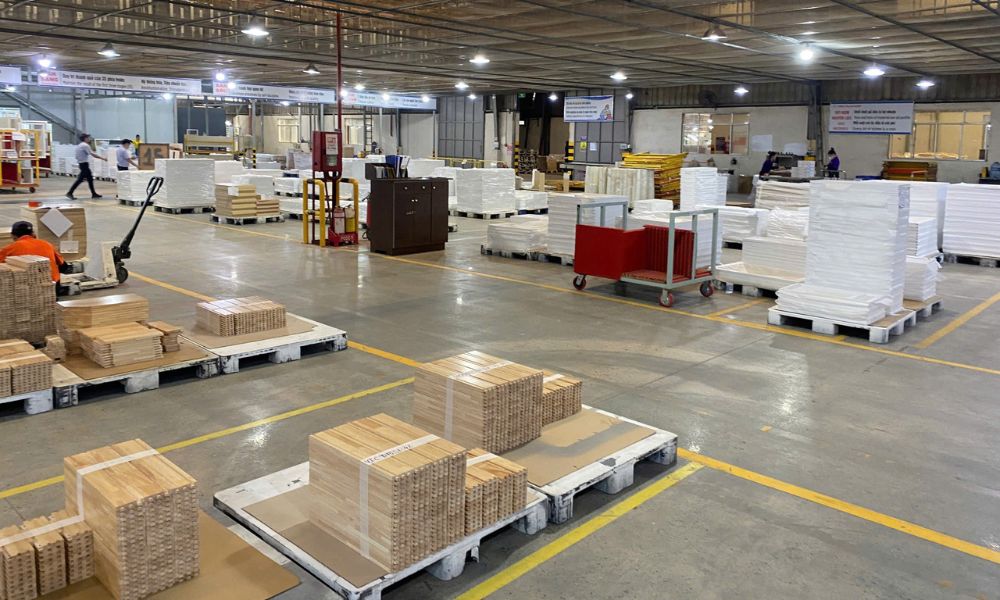
Core materials should be verified by component and documented before full OEM production begins.
Request a bill of materials that specifies core material by component, not just by cabinet line — box sides, shelves, door fronts, and face frames should each list their core material explicitly. Ask for the specific panel grade or standard referenced (APA grade for plywood, ANSI A208.2 for MDF) rather than accepting a generic “engineered wood” description, and confirm this detail is locked into your purchase order alongside the broader box construction specification your factory already follows.
This same documentation discipline extends to multifamily and production-builder orders, where hundreds of identical units built on an undisclosed core substitution compound a single material decision into a building-wide maintenance liability.
Is plywood always better than MDF for kitchen cabinets? Not universally — plywood outperforms MDF structurally and in moisture resistance, but MDF’s flat, uniform surface is genuinely better suited to painted door fronts and profiled trim, so the right answer depends on the specific component.
Why do some factories use particleboard at all if it performs worst on screw holding and moisture? Particleboard costs less and is flatter and more void-free than plywood, making it a reasonable choice for melamine-faced interior panels and shelving that will not see direct moisture or heavy repeated screw stress.
Does solid wood ever belong in cabinet boxes? Rarely in standard OEM production — solid wood’s seasonal expansion and contraction make it a poor choice for large flat box panels, though it remains standard for face frames and door frames where that same movement is manageable.
How do I verify which core material a factory actually used after the cabinets arrive? Request a pre-shipment sample cut or cross-section photo of each cabinet type before the container is sealed, since core material is difficult to verify visually once doors and finish are fully applied.
Does core material choice affect formaldehyde emissions compliance? Yes — engineered panels bonded with resin are subject to formaldehyde emission standards, so buyers should request emission test documentation for the specific MDF or particleboard core used, the same discipline that applies to any engineered wood panel in your order.
Should I expect the same core material across every SKU in a multifamily order? No — a well-run kitchen cabinet core material wholesale OEM factory varies core material by component consistently across every unit, which is different from varying it unpredictably batch to batch, the latter being the actual quality risk to watch for.
Starvia specifies kitchen cabinet core material wholesale OEM by component — plywood for boxes and moisture-exposed cabinets, MDF for painted fronts, solid wood for face frames — with bill-of-materials documentation available for buyer review before production starts. If your next order needs core material confirmed component by component, talk to our production team before you approve samples and release your deposit.

 View collection
 View collection
 View collection
 View collection