- Our Products
-
Choose your Cabinet Style
-

Kitchen cabinet organization systems wholesale OEM buyers spec make the difference between a cabinet box that just holds items and one that actually organizes a kitchen. Pull-out shelves, wire baskets, drawer dividers and adjustable shelving all draw on meaningfully different tooling and hardware sourcing than the door and drawer front itself. This guide covers the kitchen cabinet organization systems wholesale OEM buyers should understand carefully before finalizing a full program spec sheet.
Interior organization is increasingly a real buying decision on its own for many households, not just a minor accessory tacked on after the cabinet box itself has already been sold and specified.
Buyers evaluating kitchen cabinet organization systems wholesale OEM factories for the first time often assume interior hardware is a simple add-on option. In practice, shelf pin drilling patterns, slide hardware ratings and wire basket sourcing all need to be planned into the cabinet box design from the start, not bolted on afterward.
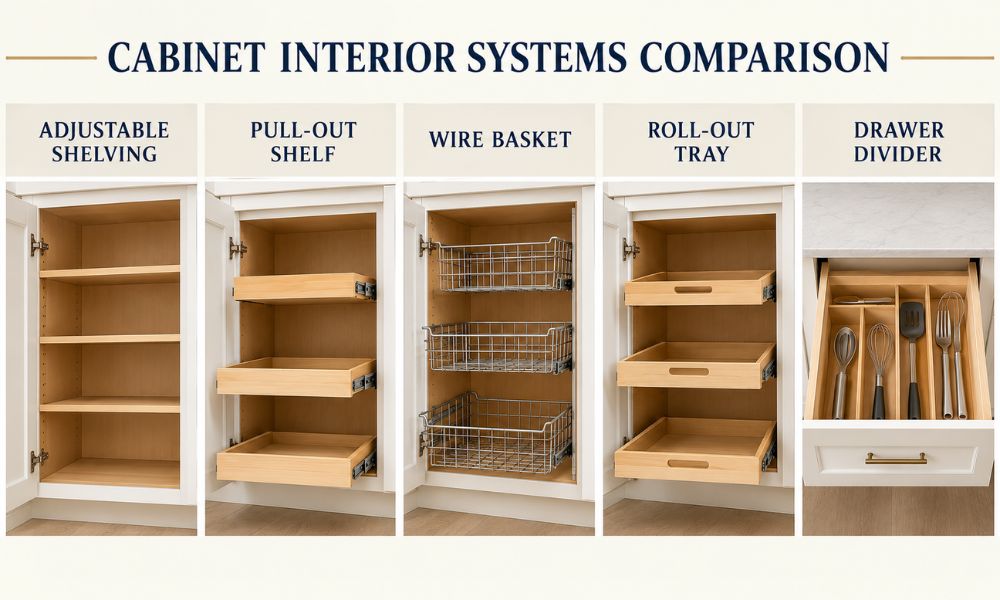
Five common cabinet organization options for wholesale OEM programs
Adjustable shelving is the baseline organization system, relying on a shelf pin drilling pattern — most commonly a 32mm line-boring system — that lets shelves move up and down inside a cabinet box. Buyers should confirm hole spacing consistency across cabinet runs, since mismatched drilling patterns make it obvious when shelves from different production batches are swapped.
Pull-out shelves extend the entire shelf surface out of the cabinet on drawer slides, giving full visibility to items stored at the back of a deep base cabinet. These are typically the highest-volume organization accessory on a wholesale program, since they upgrade almost any standard base cabinet without changing the box dimensions.
Wire baskets bring ventilation and visibility to produce storage, pantry goods or recycling bins, usually mounted on the same slide hardware as solid pull-out shelves. Epoxy-coated steel is the most common finish, chosen for durability against moisture and everyday wear.
Roll-out trays differ from pull-out shelves mainly in construction depth and edge height — trays typically have a taller lip designed to contain loose items like canned goods, while pull-out shelves use a lower or flush edge better suited to stacked plates or bulky cookware.
Drawer dividers organize utensils, cutlery and small tools inside a drawer box, ranging from simple fixed peg systems to fully adjustable tray inserts. Tray dividers, a related accessory for baking sheets and cutting boards, use vertical slots rather than horizontal shelving.
Specialty inserts — foil and wrap holders, spice pull-outs and trash bin carriers — round out a typical organization program, each requiring its own cabinet width and slide hardware specification confirmed before production.
Line-boring machines cut the repeated hole pattern that makes adjustable shelving possible, and CNC-driven line boring holds tighter hole spacing than manual drilling jigs across a full container run. Buyers comparing kitchen cabinet organization systems wholesale OEM factories should ask specifically whether shelf pin holes are cut on the same CNC pass as other panel machining or added as a separate manual step.
The 32mm system is the most widely used drilling standard, named for the spacing between hole centers, and compatibility with this standard matters most when buyers plan to source shelf pins or hardware separately from the cabinet factory itself.
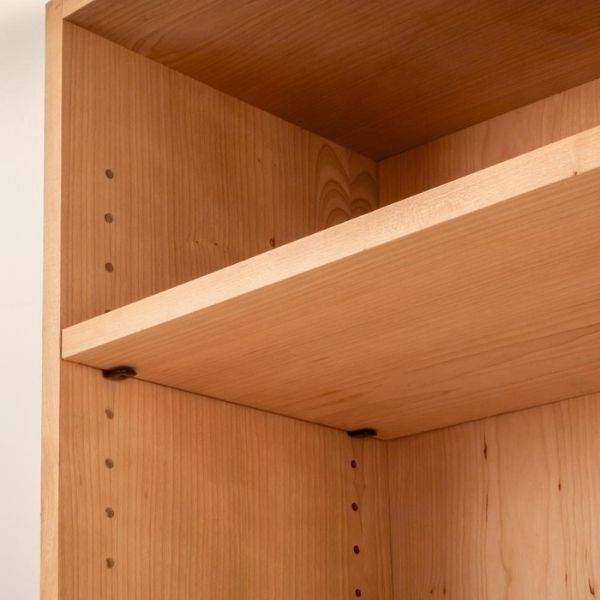
Consistent 32mm line-boring helps maintain adjustable shelf compatibility across cabinet runs.
Inspection protocol for drilled holes matters most on high-volume programs, since even a small drift in hole spacing compounds across a tall cabinet with multiple shelf positions. Factories running structured QC on line-boring output tend to catch drift before it reaches a full production run rather than after shelves arrive misaligned at a buyer’s warehouse.
Pull-out shelves and wire baskets both depend on drawer slide hardware rated for the expected load, with full-extension soft-close slides now standard on mid-to-upper programs. Buyers should confirm weight ratings specifically for pull-out shelves carrying heavier items like small appliances or canned goods, since underrated slide hardware is one of the most common warranty issues on organization accessories.
Soft-close mechanisms add a modest per-unit cost over standard slides but have become close to a baseline buyer expectation on wholesale kitchen cabinet organization systems wholesale OEM programs, particularly for wire basket pull-outs that see frequent daily use.
Slide travel distance is a related spec worth confirming, since full-extension slides let a pull-out shelf clear the cabinet face completely, while partial-extension slides leave the back portion of the shelf still inside the box. Buyers prioritizing usability over cost should default to full-extension hardware, especially on deeper base cabinets where reach-in access is otherwise limited.
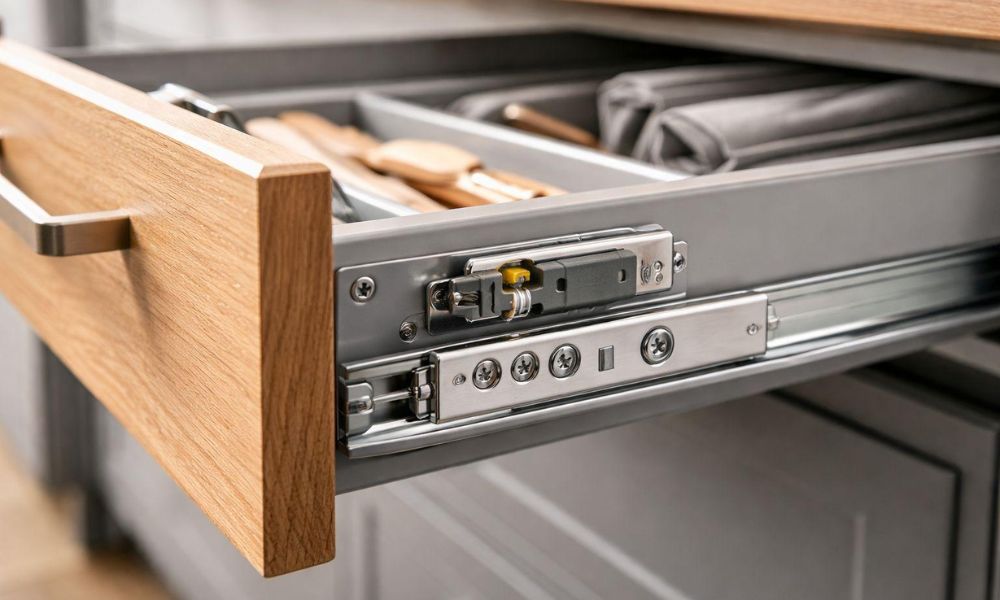
Full-extension slides provide complete access to items stored inside deep base cabinets.
Epoxy-coated steel remains the standard wire basket finish for cost and durability, though chrome and matte black finishes have grown in popularity on programs matching contemporary hardware trends elsewhere in the kitchen. Buyers should confirm wire basket finish is sourced to match or complement door hardware finishes rather than treating baskets as a hidden component with no finish coordination.
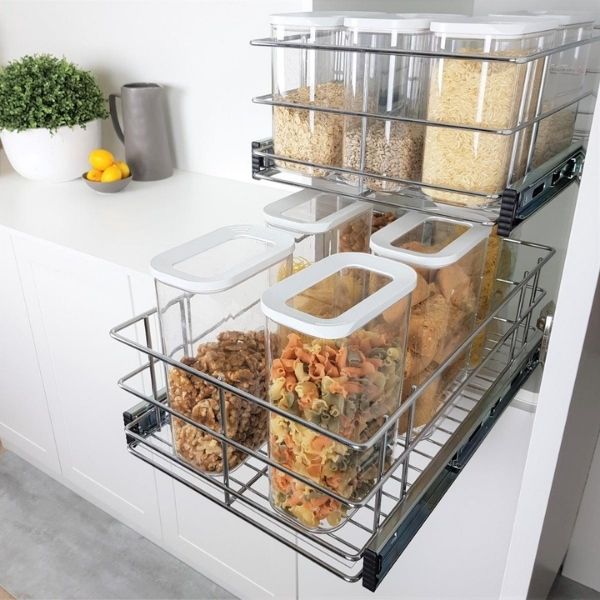
Wire basket finish and construction influence durability, appearance and perceived cabinet quality.
Basket gauge — the thickness of the wire itself — affects both load capacity and how the basket resists bending under repeated use. Thinner, lower-cost wire gauges are more prone to sagging over time, especially on wider basket widths carrying heavier pantry goods.
Weld quality at basket corners is worth a close, careful look on a physical sample, since poorly finished welds can snag fabric bags or catch on stored items during daily use. A factory experienced in wire basket production typically grinds and smooths weld points as a standard finishing step rather than leaving raw welds exposed.
Fixed peg divider systems are the lowest-cost option, using a grid of pre-drilled holes that accept movable pegs to create custom compartment sizes within a drawer box. Adjustable tray inserts, typically bamboo, acrylic or wood-veneer construction, slide directly into a drawer and offer defined compartment shapes without loose pegs.
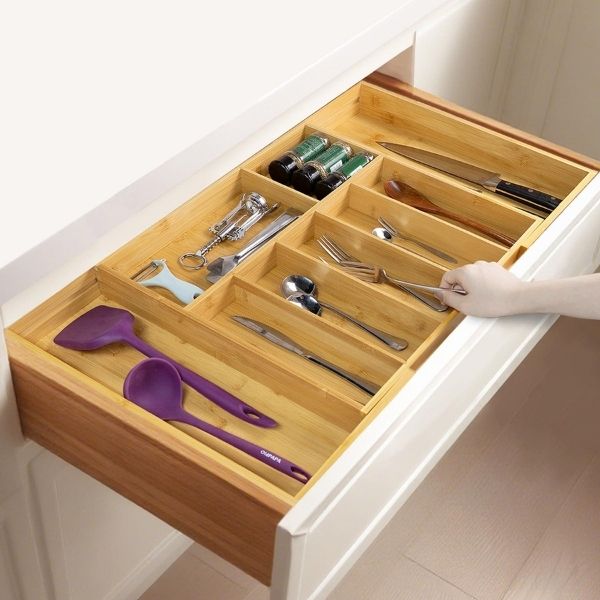
Adjustable drawer dividers and tray inserts create organized storage for utensils and kitchen tools.
Buyers specifying tray dividers for baking sheets and cutting boards should confirm the vertical slot spacing accommodates the range of pan sizes their target market actually uses, since a slot spacing designed around one region’s standard bakeware sizes may not fit imported cookware dimensions in other markets.
Material choice on tray inserts affects both cost and perceived quality. Bamboo and solid wood-veneer trays read as a premium detail worth showing off when a drawer opens, while molded acrylic and plastic inserts prioritize low cost and moisture resistance over visual presentation.
Organization accessories typically quote as line items added to a standard cabinet program rather than changing the base container MOQ, so a buyer can add pull-out shelves or wire baskets to select cabinet openings without restructuring the whole order. Buyers should request itemized pricing per accessory type rather than a single bundled organization package, since accessory mix varies significantly between builder-grade and premium programs.
Sample review matters here even more than on some other components, since slide smoothness and basket finish quality are hard to judge from a spec sheet or photo alone. Requesting a working sample of each accessory type before a first full container order helps confirm hardware quality actually matches the quoted specification in hand.
Lead time impact from organization accessories is typically minor, since slide hardware and baskets are usually installed during final assembly rather than requiring a separate production stage on the factory floor. Programs adding a wide range of specialty inserts for the first time should still build in extra days for sample approval across each accessory type before committing to a full container order.
Corner cabinet mechanisms like lazy susans and blind-corner pull-outs solve a specific geometry problem and are typically specified as their own line item separate from general kitchen cabinet organization systems wholesale OEM accessories covered here. Buyers researching corner-specific mechanisms should review corner cabinet solutions separately, since the mechanism types and tooling requirements differ meaningfully from straight-run pull-outs and wire baskets.
Builder-grade and mid-market programs generally do well with a focused package — adjustable shelving as standard, with pull-out shelves and drawer dividers offered as upgrade options on select cabinet runs. Premium and high-end residential programs increasingly expect wire baskets, soft-close pull-outs and tray dividers as standard inclusions rather than paid upgrades.
Multifamily and rental-unit programs should weight durability and simplicity, favoring standard adjustable shelving and basic drawer dividers over specialty inserts that add cost without matching tenant turnover expectations.
Mixed programs — a builder offering both a base finish package and a premium upgrade tier — can often spec adjustable shelving and basic pull-outs across most units while reserving wire baskets and specialty inserts for model units or upgrade packages, provided the factory can hold consistent hardware quality across both tiers.
What is the standard shelf pin drilling system? The 32mm line-boring system is the most widely used standard, spacing hole centers 32mm apart to support adjustable shelving compatible across most cabinet hardware brands.
Are soft-close slides standard on pull-out shelves? Soft-close has become close to a baseline expectation on mid-to-upper wholesale programs, though builder-grade programs may still offer standard slides as the base spec with soft-close as an upgrade.
What material are wire baskets typically made from? Epoxy-coated steel is the standard finish for cost and durability, with chrome and matte black available on programs matching contemporary hardware trends.
Are lazy susans part of a standard organization package? No — corner mechanisms like lazy susans are typically quoted separately from straight-run organization accessories, since they solve a different cabinet geometry problem.
Can organization accessories be added to an existing cabinet order? Yes, provided cabinet openings are already sized to accept standard slide hardware, though shelf pin drilling patterns should ideally be planned into the original production run.
What is the difference between full-extension and partial-extension slides? Full-extension slides let a pull-out shelf clear the cabinet face completely for full reach-in access, while partial-extension slides leave part of the shelf inside the cabinet box.
For buyers comparing kitchen cabinet organization systems wholesale OEM against a specific program, review hinge and hardware options, confirm corner cabinet mechanisms, and check current FOB pricing benchmarks before finalizing a spec sheet.
First-time buyers should also confirm MOQ requirements and review factory lead times so sample approval and production scheduling line up before a container is booked.
External references: NKBA design guidelines, NAHB housing and remodeling data, and FSC chain-of-custody standards provide independent context on design, hardware and material sourcing practices referenced throughout this full guide.
For sourcing questions on a specific organization accessory program, reach out to the Starvia OEM team to review sample hardware from a Vietnam-based production line running CARB Phase 2 certified output at ±0.5mm CNC tolerance across pull-out shelves, wire baskets and drawer divider configurations.

 View collection
 View collection
 View collection
 View collection