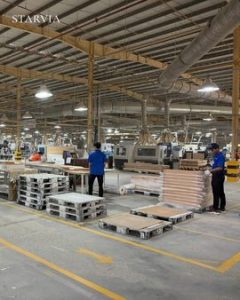
- Our Products
-
Choose your Cabinet Style
-

69% of NKBA design professionals say flat-panel doors are gaining ground for 2026, second only to Shaker in overall specification. For any importer building next year’s catalog, a slab door kitchen cabinets manufacturer Vietnam program is the fastest way to capture that shift without the labor premium US and EU shops now charge for minimalist millwork.
This guide breaks down what a slab door actually is, why designers are moving toward it, what materials and finishes a Vietnam factory can run at wholesale volume, and how FOB pricing, MOQ, lead time, and quality control compare to Shaker and raised panel programs. By the end you should be able to write a spec sheet and know exactly what to inspect before a container leaves the port.
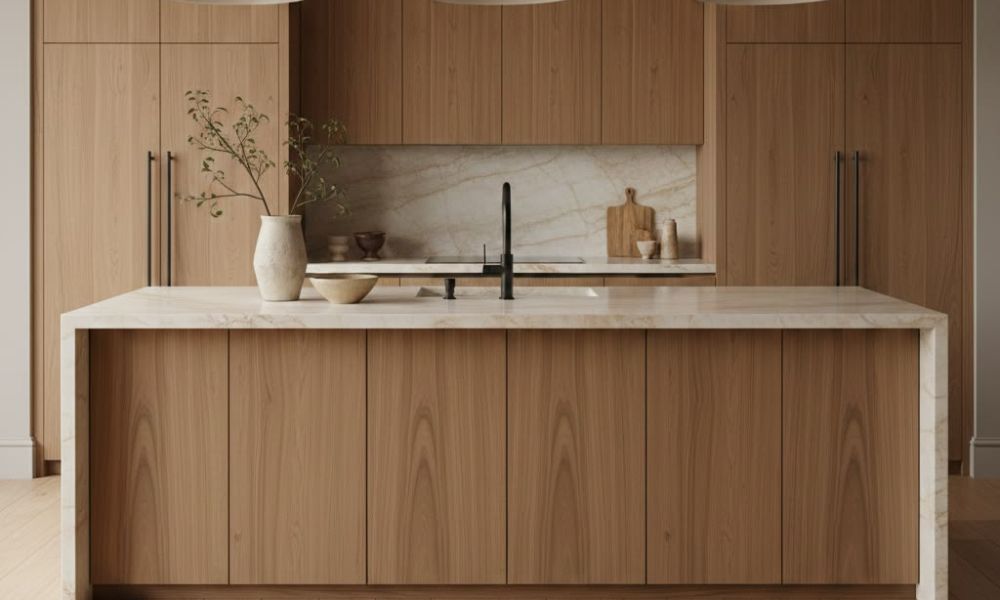
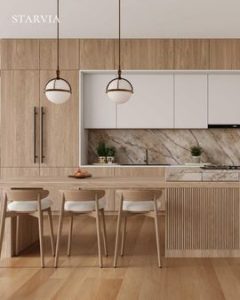
Modern slab door kitchen cabinets manufactured in Vietnam for wholesale and OEM programs.
A slab door is a single flat panel with no frame, no raised center, and no applied molding. It is the cleanest possible cabinet front, which is exactly why it reads as “modern” or “minimalist” in showrooms. Because there is no profile to route or assemble, a slab door kitchen cabinets manufacturer Vietnam factory can produce it faster per unit than a five-piece Shaker or raised panel door.
Slab doors are built from one of three substrates: MDF with a painted, thermofoil, or high-gloss acrylic finish; plywood with a wood veneer face; or particleboard with melamine or laminate. Substrate choice drives both price and durability, which we cover in the materials table below.
Some buyers use “flat-panel” and “slab” interchangeably, and in practice most factories do too. The one distinction worth holding onto is edge treatment: a true slab door has a machined or PVC edge band on all four sides, while a “flat-front” laminate door sometimes wraps a single continuous sheet with no visible seam at all.
The NKBA/KBIS 2026 trends report found that 69% of surveyed design professionals see flat-panel styling gaining popularity, alongside 72% who see panel-faced refrigeration and 85% who see panel-faced dishwashers trending upward. Read the full report from the National Kitchen & Bath Association.
The same report puts transitional/timeless design at 72% popularity and contemporary/minimalist styling at 60%, which explains why a slab door kitchen cabinets manufacturer Vietnam partner is now fielding more RFQs for flat-front programs than five years ago. Buyers are not chasing a fad; they are matching a documented shift in what homeowners and builders are asking contractors for.
Panel-ready appliances reinforce the same trend. When 85% of designers expect dishwashers to disappear behind a matching cabinet front, the door style around them has to be flat enough that the seam is invisible — a detail Shaker and raised panel profiles cannot deliver as cleanly.
Not every slab door is priced or built the same way. The table below reflects typical wholesale ranges quoted by Vietnam factories for container-volume orders, ex-factory.
| Substrate | Finish | FOB Price/Linear Ft (USD) | Best For |
|---|---|---|---|
| Particleboard | Melamine | $45 – $70 | Budget multifamily, rental units |
| MDF | Thermofoil | $60 – $95 | Mid-market production builders |
| MDF | Painted (matte/satin) | $85 – $130 | Retail showroom, remodel programs |
| MDF | High-gloss acrylic | $110 – $160 | Premium contemporary lines |
| Plywood | Wood veneer | $120 – $175 | High-end custom and hospitality |
Matte and satin finishes now account for roughly 70% of painted-door orders industry-wide, a shift away from high-gloss that a slab door kitchen cabinets manufacturer Vietnam factory needs to stock in its standard color library, not just as a custom add-on. Buyers who default to gloss because it photographs well are increasingly out of step with what their own designers are specifying.
Color trends matter here too. Warm neutrals, greige, and deep sage green are the three fastest-moving slab colorways this cycle, ahead of the stark white that dominated the last five years of minimalist kitchens.
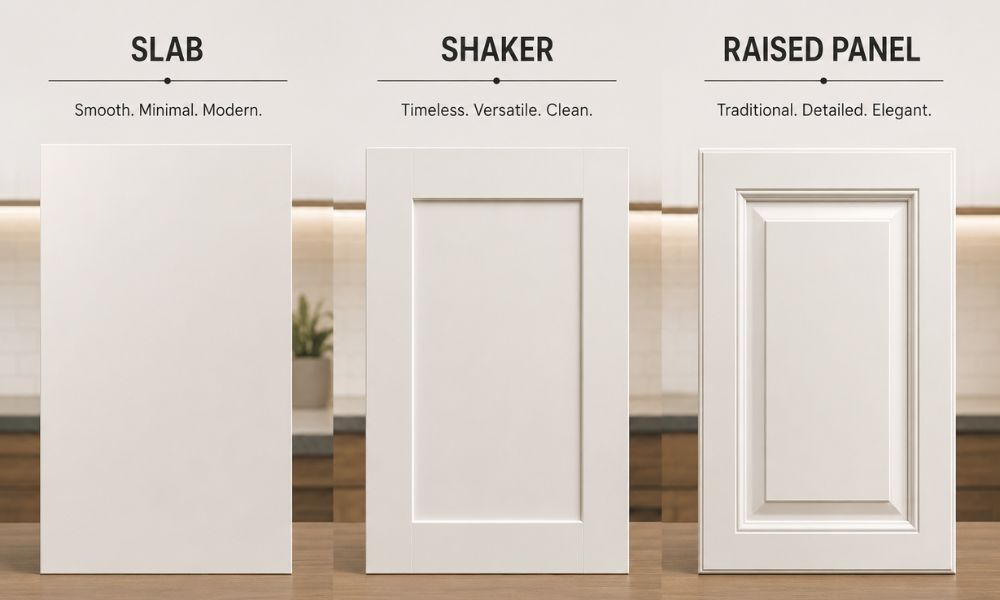
A visual comparison of slab, Shaker, and raised panel cabinet door styles.
Shaker remains the volume leader for a reason: it hides substrate seams and minor MDF imperfections behind its frame-and-panel construction. If your buyer program already runs white Shaker cabinets, slab is a natural second SKU line for the same customer base rather than a replacement.
Raised panel sits at the opposite end of the design spectrum from slab — ornate, traditional, and increasingly a smaller share of new-build specs. If you carry both, our raised panel cabinet manufacturing guide covers the tooling differences your factory needs to run both profiles on one line.
The practical difference for a buyer: slab doors ship with less crating protection needed for the profile itself, but face edges and corners are far more visible to the eye, so factory-level QC on delamination and edge-banding is non-negotiable. A dealer stocking all three profiles typically sees slab and Shaker split roughly 55/45 of new orders, with raised panel now a specialty request rather than a core line.
Slab door programs typically run 10–20% below an equivalent Shaker SKU at the same substrate tier, because there is no five-piece assembly labor. For exact container math, see our breakdown of 2026 kitchen cabinet FOB pricing.
Minimum order quantities follow the same logic as any other door style at a Vietnam factory — volume, not door profile, drives the floor. Our MOQ guide walks through how factories set that threshold and where a first-time importer can negotiate a smaller opening order.
Freight is the other line item buyers underestimate. Container rate volatility on the Vietnam-to-US trade lane can move landed cost more than the door style choice does — track current spot rates through Freightos before locking a quote, and rebuild your landed-cost model whenever rates move more than 10% from your last order.
Because a slab door has no frame to disguise flaws, four checks matter more here than on any other profile. First, edge banding must be PUR hot-melt, not EVA, or it will lift at high humidity during ocean transit. Second, MDF core density should sit at 45–48 lb/ft³ minimum to resist warping over a 30–40 day sea voyage.
Third, request the factory’s formaldehyde emissions documentation for any composite wood substrate — CARB Phase 2 or TSCA Title VI compliance is the baseline US importers should require. Check current requirements through the California Air Resources Board composite wood program page.
Fourth, on high-gloss acrylic specifically, ask for a scratch-resistance test report before container loading. A slab door kitchen cabinets manufacturer Vietnam factory that cannot produce these four documents on request is a factory you should keep evaluating, not signing.
A fifth check worth adding to your pre-shipment inspection: color consistency across the full door run under one light source. Slab surfaces show batch-to-batch color drift far more visibly than a profiled door, where shadow lines mask minor variation.
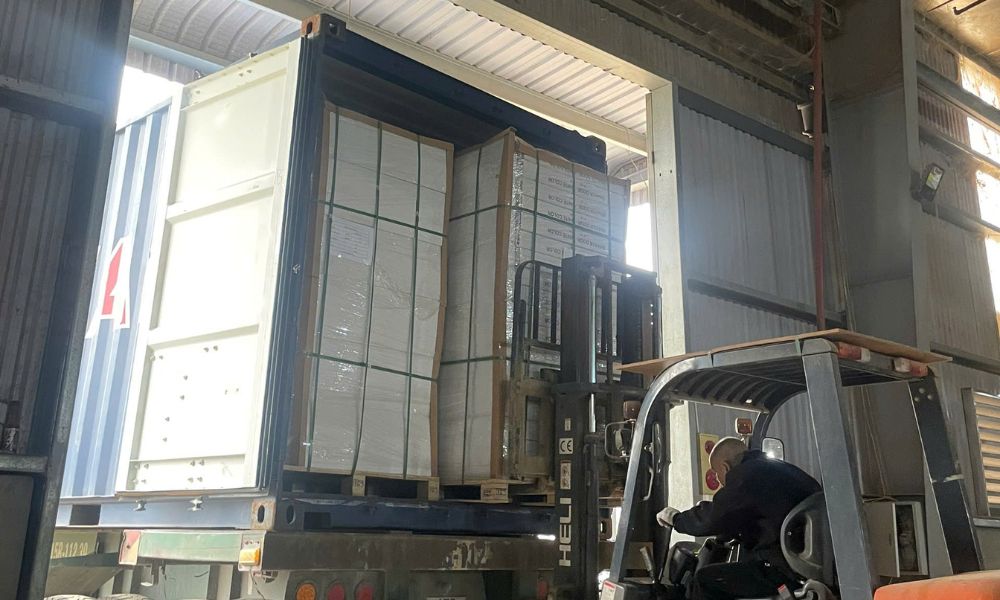
Protective packaging helps prevent chipped corners and damage during ocean transportation.
Corner protection is the single biggest packaging difference between slab and profiled doors. With no raised edge to absorb impact, every slab door needs foam corner guards and edge protectors, not just interleaved cardboard, or you will see chipped corners on arrival.
Doors should be palletized face-to-face in matched pairs and strapped, not stacked loose, to prevent bowing during a multi-week ocean transit. A reliable slab door kitchen cabinets manufacturer Vietnam supplier will photograph the container load before sealing and share it as part of standard QC, not as a special request.
Tooling cost is the biggest practical difference. Slab doors need almost no specialized tooling compared to a five-piece Shaker or raised panel line, which narrows the cost gap between Vietnam and China factories more than it does for profiled doors — the labor-rate advantage that usually favors Vietnam matters less when there is less labor to begin with.
Where Vietnam still separates itself is compliance documentation and trade-lane stability for US-bound freight. Buyers running a slab door kitchen cabinets manufacturer Vietnam program consistently report faster, more complete CARB and TSCA paperwork than they get from smaller Chinese subcontractors, which matters more at customs than a few cents per linear foot.
The other factor worth weighing is finish consistency at scale. A high-gloss acrylic slab door shows every batch variation, and factories with tighter QC systems — regardless of country — will outperform a cheaper quote that cannot guarantee color match across a multi-container order.
Is a slab door kitchen cabinets manufacturer Vietnam program more expensive than Shaker? No — slab typically runs 10-20% below an equivalent Shaker SKU at the same substrate and finish tier, because the door requires no frame assembly.
What substrate holds up best for export? MDF with PUR edge banding is the most humidity-stable choice for ocean freight; particleboard is the most price-sensitive but least tolerant of moisture swings.
How long does a first sample take? Two to three weeks from an approved spec sheet is standard among established Vietnam factories.
Do slab doors need special hardware? No — standard concealed European hinges and soft-close slides work with slab doors; the only spec change is hinge boring depth on thinner MDF panels below 3/4 inch.
Can one factory run slab and Shaker on the same order? Yes, most established Vietnam OEMs run mixed-profile orders on one production line, which is useful for buyers testing a new slab SKU alongside an existing Shaker catalog.
Slab doors generally shave a few days off total production time versus Shaker, since there is no frame-and-panel assembly step before finishing. That said, factory-wide lead time is still driven mainly by order volume and finishing queue, not door profile — see our full Vietnam OEM factory lead time guide for planning a launch date around a container ship schedule.
Painted and high-gloss finishes add the most time to a slab program because of multi-coat curing schedules. Build in a buffer of one to two extra weeks for any painted slab order over 200 doors, especially during peak shipping season when factory finishing lines run at full capacity.
Start with a physical sample door, not a photo. Finish consistency, edge quality, and substrate weight are impossible to judge from a rendering, and a serious slab door kitchen cabinets manufacturer Vietnam supplier will ship a sample within two to three weeks of a spec sheet.
Confirm door count per SKU, hinge boring pattern, and packaging spec before the first production run, then lock a second-container reorder timeline so the factory can hold capacity. Starvia runs slab, Shaker, and raised panel programs on the same production floor for US, Canadian, Australian, and European wholesale buyers, with sample turnaround and container-load QC built into every order.
Ready to price a slab door program at your target volume? Request a quote from Starvia and get a factory-direct FOB estimate within two business days.

 View collection
 View collection
 View collection
 View collection