- Our Products
-
Choose your Cabinet Style
-

Cabinet pull and handle finishes wholesale OEM buyers select today directly affect two things a spec sheet rarely mentions: how the product photographs on day one, and how it looks after two years of daily use. A finish that looks identical to a competitor’s sample can behave completely differently once it meets kitchen humidity, hand oils, and cleaning chemicals.
This guide covers which finishes are moving volume right now, what actually separates a durable finish from one that will tarnish within a year, and what to specify when placing a wholesale hardware order. Understanding cabinet pull and handle finishes wholesale OEM requirements before sourcing helps buyers compare coating technologies, evaluate long-term durability, and select finishes that match different cabinet collections and market segments.
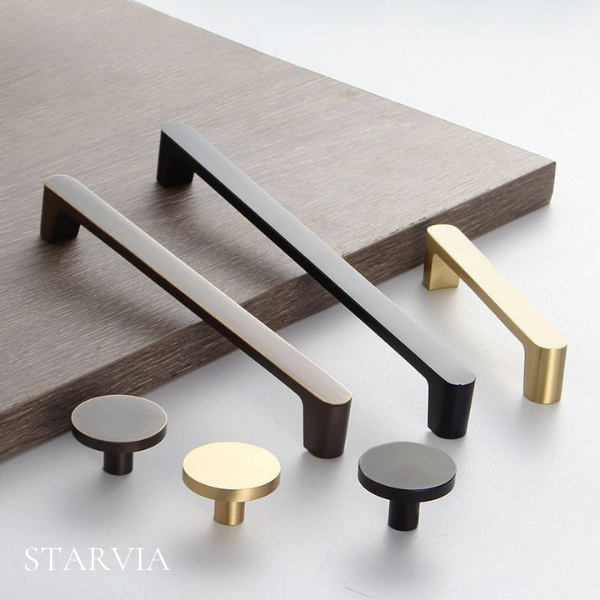
The finishes most commonly requested by wholesale cabinet buyers.
Demand has shifted away from the bright chrome and polished stainless finishes that dominated the last decade toward warmer, softer tones. Brushed brass, satin nickel, matte black, graphite, and oil-rubbed bronze now account for the bulk of new SKU requests from wholesale buyers stocking for the current season.
Matte black remains a strong performer, particularly against white or light-toned cabinetry where it creates a crisp outline. But it is no longer the default single finish on a project – many specifiers are now mixing warm brass pulls with matte black or graphite appliance and door hardware to break up a single repeated finish across a kitchen.
Unlacquered brass, which develops a natural living patina over time, has also picked up interest from buyers targeting a higher-end aesthetic. It behaves differently from a sealed finish and needs to be sold with that expectation set clearly, since a living finish is not a defect – it is the intended behavior of the material.
The finish name on a spec sheet – brushed brass, matte black, satin nickel – describes color and texture, not durability. The coating process behind that finish determines how long it actually holds up, and this is the detail most wholesale buyers skip past.
Physical Vapor Deposition (PVD) applies a thin, extremely hard metallic layer directly onto a base metal, typically zinc alloy or 304-grade stainless steel, through a vacuum deposition process. PVD-coated hardware resists tarnishing, scratching, and fingerprint marking significantly better than traditional electroplated or lacquer-sealed finishes, which can wear through with repeated handling.
Electroplating and lacquer coatings are cheaper to produce and can look identical to PVD on day one, which is exactly why buyers get burned on this distinction. A lacquer-sealed finish that looks fine in a showroom sample can show wear at contact points – around the pull’s grip area – within six to twelve months of daily kitchen use, while a PVD-coated equivalent holds its finish for years under the same handling.
A side-by-side comparison of the three coating processes makes the trade-off clear for wholesale buyers weighing cost against expected product lifespan.
| Coating Process | Relative Cost | Typical Wear Point | Best Fit |
|---|---|---|---|
| PVD (vacuum deposition) | Higher | Years of daily handling | Premium and mid-premium SKUs |
| Electroplating | Mid | 12–24 months at grip points | Value-tier programs with shorter replacement cycles |
| Lacquer-sealed | Lowest | 6–12 months at grip points | Budget SKUs, display samples |
When evaluating cabinet pull and handle finishes wholesale OEM programs, buyers should compare coating technology, base material, expected service life, and warranty support rather than relying only on appearance or price.

Hardware specifications should include coating type and base material.
Ask any factory or hardware supplier directly whether a finish is PVD-coated, electroplated, or lacquer-sealed – the finish name alone will not tell you. Cabinet pull and handle finishes wholesale OEM buyers who skip this question are effectively buying on appearance alone and finding out about durability after the product ships.
Base material matters alongside the coating. Solid zinc alloy or brass construction holds a coating and resists denting better than hollow or pot-metal alternatives, particularly on longer bar pulls that see more leverage stress during daily use. Ask for base material specification together with coating type, since either one alone is an incomplete picture of durability.
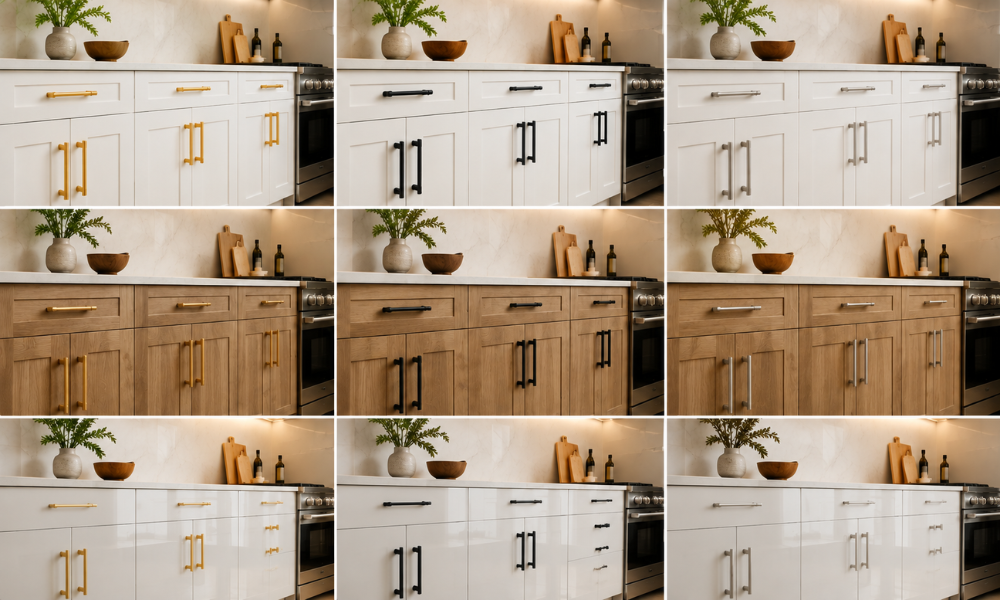
Different cabinet finishes create different visual effects with the same hardware.
Finish selection interacts with the cabinet finish it sits against more than most buyers plan for. Warm brass and satin gold read differently against a high-gloss lacquer door than against a matte or textured surface, and matte black behaves differently against light versus dark cabinetry. Reviewing our high gloss cabinet finish guide is useful before finalizing a hardware pairing for a glossy product line.
Hardware also needs to match the mounting hole spacing and reveal specifications of the cabinet door and drawer front it’s paired with. A pull specified for a 96mm hole spacing will not retrofit onto hardware pre-drilled for 128mm without redrilling, which matters when a wholesale buyer is stocking hardware for multiple cabinet lines with different specifications. Our cabinet hardware guide covers spacing standards across common cabinet lines in more detail.
Successful cabinet pull and handle finishes wholesale OEM sourcing also considers cabinet style, door finish, lighting conditions, and customer preferences to ensure a consistent final appearance across the project.
Request a physical sample rather than relying on a photo before committing to a bulk order. Photos consistently misrepresent warm-tone finishes like brass and champagne gold, which shift noticeably under different lighting conditions and camera white balance settings.
Run a basic durability check on the sample: repeated wiping with a damp cloth and mild cleaning solution, and light abrasion at the grip point, will reveal within minutes whether a finish is a durable PVD coating or a thinner lacquer that will show wear in real use. This five-minute test at the sourcing stage prevents a much larger problem after a full container has shipped.
Hinges see similar coating and base-material trade-offs as pulls and handles, since both are touched constantly and exposed to the same kitchen environment. Our hinge types overview covers the equivalent durability questions for cabinet hinges.

Comparing cabinet hardware finish samples before selecting the right option for an OEM cabinet project
Stocking a single finish per cabinet line is no longer sufficient for buyers serving designers who mix metals within one kitchen. A wholesale buyer sourcing cabinet pull and handle finishes for OEM production should plan SKU coverage across at least three finish families – a warm metal (brass or gold), a cool metal (nickel or chrome), and a dark finish (matte black or graphite) – to match current NKBA-documented design direction toward mixed-metal kitchens.
Matching finish availability to actual demand also reduces dead stock. Ordering evenly across finish families without checking which ones a target market is actually specifying leads to overstock on finishes falling out of favor and stockouts on the warm-tone finishes currently driving demand.
Cabinet pull and handle finishes wholesale OEM programs are typically organized into entry, mid-range, and premium pricing tiers to serve different customer segments. An entry tier can use electroplated finishes with clear expectations set on replacement cycle, while mid and premium tiers move to PVD-coated hardware where the higher unit cost is justified by a multi-year finish life.
Buyers who blend coating types across a single product line without clearly labeling which is which tend to generate the most warranty complaints, since a customer comparing two similar-looking finishes has no way to know one will outlast the other by years. Clear SKU-level documentation of coating type protects both the buyer’s margin and the end customer’s expectations.
Consistent hole spacing, secure fastening points, and finish uniformity across a production run depend on the same manufacturing discipline that governs the cabinet boxes the hardware attaches to. Buyers evaluating a Vietnam OEM factory for cabinetry should ask whether hardware sourcing and installation follow the same quality process referenced by organizations like AWMAC for architectural woodwork standards.
A factory holding tight CNC tolerance on door and drawer fronts – inside the ±0.5mm range – tends to also hold tighter tolerance on hardware mounting hole placement, since both depend on the same production equipment and quality control process.
Building this level of specification into a wholesale purchase order takes only slightly longer than ordering by finish name and photo, and it is the single biggest factor separating a hardware program that holds up in the field from one that generates returns and complaints within the first year.
What’s the difference between PVD and electroplated hardware finishes?
PVD applies a hard metallic coating through vacuum deposition that resists scratching and tarnishing significantly longer than electroplating, which uses a thinner, softer metal layer that wears at contact points over time.
Which cabinet pull and handle finishes wholesale OEM buyers should stock as a base lineup?
A warm metal such as brushed brass, a cool metal such as satin nickel, and a dark finish such as matte black or graphite cover the bulk of current mixed-metal demand across most kitchen styles.
Does unlacquered brass need special handling instructions for buyers?
Yes. Unlacquered brass develops a living patina intentionally, and buyers should communicate this to end customers so the natural color shift isn’t mistaken for a manufacturing defect.
How do I test hardware durability before placing a bulk order?
Request a physical sample and run a damp-cloth wipe test plus light abrasion at the grip point. A durable PVD-coated finish will show minimal wear; a thinner lacquer or electroplated finish often shows marking within this quick test.
Does hardware need to match hole spacing across different cabinet lines?
Yes. Pulls and handles are manufactured for specific hole spacing standards, and a mismatch between hardware and pre-drilled cabinet fronts requires redrilling rather than a direct swap.
Is there a visual way to tell PVD from electroplating before running the wipe test?
Not reliably. Both processes can produce a nearly identical initial appearance across brushed brass, satin nickel, or matte black finishes. The coating specification from the supplier, backed by the damp-cloth and abrasion test on a physical sample, is the only dependable way to confirm which process was used.
Do mixed-metal kitchens need matching coating types across finishes?
Not necessarily matching type, but matching durability tier is worth confirming. A kitchen pairing a PVD-coated brass pull with an electroplated black hinge will show uneven wear over time, even though the visual mismatch was intentional and the durability mismatch was not.

Reviewing hardware samples before placing a wholesale order helps avoid costly mistakes.
Cabinet pull and handle finishes wholesale OEM buyers choose should be evaluated on coating process and base material, not just the finish name on a catalog page. Selecting the right cabinet pull and handle finishes wholesale OEM solution means balancing appearance, durability, coating technology, and long-term value for every project. A brushed brass or matte black pull that uses genuine PVD coating over solid zinc alloy or brass will outlast a visually identical lacquer-sealed alternative by years, not months.
Request coating specifications, run the damp-cloth test on samples, and confirm hole spacing compatibility before finalizing a bulk order. Reach out through our about page to start a sourcing conversation with a Vietnam OEM factory that specifies hardware coating and base material clearly.
The finish that looks best in a supplier’s catalog photo is rarely the detail that determines whether a wholesale hardware program succeeds. Coating process, base material, and hole spacing accuracy are the three specifications that actually protect margin and reputation once product ships and reaches daily use in a real kitchen.




 View collection
 View collection
 View collection
 View collection